






















































































MARCH 24, 2026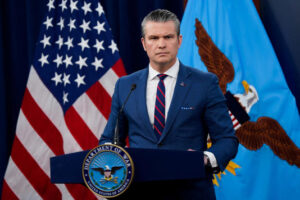
Defense Secretary Pete Hegseth updates reporters at the Pentagon on March 2, 2026, of the U.S.-Israeli war against Iran. – Elizabeth Frantz, REUTERS
Pentagon chief Pete Hegseth announced two major changes to the military’s chaplaincy corps on March 24, one of which will mean chaplains will no longer wear their rank insignia.
They will instead display their religious insignia while retaining their rank as officers. They “will be seen among the highest ranks because of their divine calling,” Hegseth said in a video posted to X.
The change reflects Hegseth’s wider effort to infuse the chaplaincy, and the military more broadly, with more explicitly religious sentiments.
Service members’ spiritual health should be seen as equally important as physical and mental health, Hegseth said, lamenting what he said was the chaplaincy’s misguided shift away over the years from focusing on religious faith in favor of “self-help and self-care.”
“A warfighter needs more than a coping mechanism,” he said. “They need truth, big-T truth, they need conviction, they need a shepherd.”
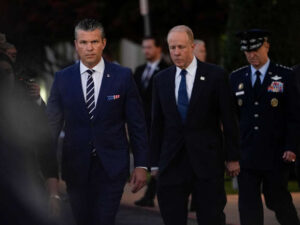
U.S. Defense Secretary Pete Hegseth arrives prior to the United States flag being unfurled at the Pentagon on Sept. 11, 2025, in Arlington, VA. On Sept. 11, 2001, American Airlines Flight 77 was deliberately crashed into the Pentagon, killing 184 people. – Jack Gruber, USA TODAY
Hegseth also said the move would make chaplains more accessible by reducing “any unease or anxiety” service members may have about approaching a superior to discuss sensitive issues.
He also announced that the Pentagon would be using 31 faith codes moving forward instead of the more than 200 previously recognized. He called that higher number an “impractical and unusable system.”
A smaller, more streamlined system will support chaplains in “minister(ing) to service members in a way that aligns with that service member’s faith background and religious practice,” Hegseth said.
He said the Pentagon is “not even close to being done” in taking steps toward “restoring the esteemed position of chaplain.”
“You have a sacred calling,” Hegseth said in closing. “So preach the truth, be steadfast in your faith, and shepherd the flock entrusted to you.”
A history of debates over religious diversity in the military
President George Washington established the Chaplain Corps in 1775. It was exclusively Protestant at its founding but introduced Catholic chaplains and a rabbi in the 19th century. The first Muslim chaplain came in 1994, and the first Buddhist chaplain followed in 2008.
There has been an array of controversies and debates over the extent to which the military should accommodate religious expression over the years.
The U.S. Supreme Court in 1986 ruled that the Air Force could prohibit an Orthodox Jewish service member from wearing a yarmulke while in uniform. Though it restrained his religious expression, the court said the ban “reasonably and evenhandedly” supported the military’s “perceived need for uniformity.”
In the early 2000s, there were allegations that Air Force Academy officers and cadets were proselytizing in support of evangelical Christian beliefs, fostering a less welcoming environment for service members of other faith traditions.
Army Chaplain Corps guidelines published during former President Joe Biden’s administration in February 2024, which remained on the Army’s website following the March 24 announcement, said the Chaplain Corps at that point represented more than 100 religious groups.
The Chaplain Corps “cares for all Soldiers and their Families, regardless of their religious preferences, and even when they have no religious preference at all,” it said. It added that recruiters were “actively working to increase the Corps’ diversity” at that point, particularly as it related to more women serving as chaplains and more representation of minority faiths in the chaplaincy.
Former military chaplains previously expressed concern over the Pentagon’s more explicitly religious vision under President Donald Trump’s administration in interviews with USA TODAY. The Military Religious Freedom Foundation reported earlier in March that it had received more than 200 complaints related to religious freedom from service members in the wake of the United States’ war in Iran.
Courtesy/Source: This article originally appeared on USA TODAY