





















































































MAY 4, 2026
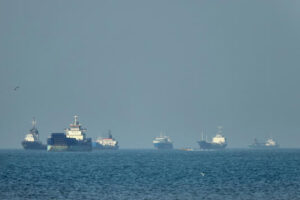
Cargo ships sit at anchor in the Strait of Hormuz near Bandar Abbas, Iran. – Amirhosein Khorgooi/ISNA/AP
Fighting in the Iran war flared for the first time in weeks, as strikes on a crucial United Arab Emirates oil port and several ships amid Iranian threats tested a shaky cease-fire.
The U.A.E., which has backed tougher action against Iran, sounded alerts for the first time since early April, saying it was targeted by four missiles and a number of drones. It confirmed a drone hit sparked a fire at the crucial oil hub of Fujairah, which the country has used to pump much of its petroleum output around Iran’s chokehold on the Strait of Hormuz.
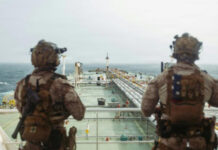
U.S. military forces including warships and aircraft actively protected several commercial vessels from Iranian attacks Monday, a senior U.S. official said. Sailors reported witnessing a successful drone strike on a tanker named JV Innovation and military jets buzzing overhead.
Military tensions flared in the Strait of Hormuz on Monday, as several vessels were struck amid Iranian threats, while the U.S. sent in destroyers and fought off further attacks.
The skirmishing came hours after President Trump announced a new initiative to get ships that have been bottled up in the Persian Gulf out through the crucial waterway. Iran’s chokehold on the strait and an American blockade of Iranian ports have deprived global markets of millions of barrels of oil and are putting increasing pressure on Iran’s economy.
The American military said it successfully guided two U.S.-flagged commercial ships through the strait, marking the start of Trump’s operation to free up international traffic in the strategic waterway. U.S. forces didn’t physically escort the merchant vessels, but instead established a defensive shield using warships and aircraft to protect them, the senior official said.
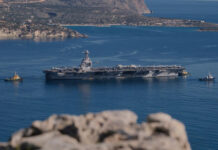
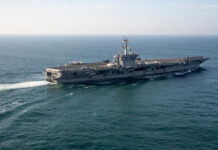
Later, U.S. Navy guided-missile destroyers supporting the effort sailed through the strait, the senior official said. The warships are currently operating in the gulf, according to the U.S. Central Command, which oversees the Middle East.
“American forces are actively assisting efforts to restore transit for commercial shipping,” Centcom said.
U.S. warships last sailed into the strait in early April, the first time they had entered the waterway since the war began.
Trump announced his new effort, called Project Freedom, on social media Sunday. The U.S. has reached out to hundreds of commercial ships in the Gulf and encouraged them to attempt to transit the strait.
Iran’s Islamic Revolutionary Guard Corps, whose navy has choked off traffic in the strait, defied the initiative Monday, saying ships going through without its permission face serious risks.
“There has been no change in the management of the Strait of Hormuz,” Sardar Mohebbi, a spokesman for the Revolutionary Guard, said according to Tasnim, a news agency affiliated with the paramilitary group. “Maritime movements contrary to the principles announced by the IRGC Navy will face serious risks. Violating vessels will be stopped by force.”
The captain of the Marshall Islands-flagged JV Innovation said it was at anchor Monday waiting to cross the strait when it was hit by a drone. Sailors on nearby ships reported seeing the strike and a fire on the deck.
Another ship, the HMM Namu, was struck by an explosive late Monday, according to maritime security company Vanguard.
Separately, the United Arab Emirates on Monday condemned what it said was an Iranian drone attack on a tanker used by the state-owned oil company of Abu Dhabi, Adnoc. Two drones targeted the ship while it was transiting the strait, causing no injuries, the Emirati Foreign Ministry said. The statement didn’t say when the attack took place.
Iranian state media published a map Monday of the Revolutionary Guard’s area of control of the strait that encompassed the U.A.E. port of Fujairah, the end of a pipeline that the Gulf country uses to circumvent the blockage in the strait.
The developments have renewed uncertainty around the fate of the world’s most important energy shipping lane, which Iran closed after the U.S. and Israel launched their attack on the country. Millions of barrels of oil have been cut off and hundreds of ships are stranded in the Gulf with their crews.
The U.S. has responded with a blockade of Iranian ports and by intercepting sanctioned ships in the shadow fleet that is moving Iranian oil. Oil prices jumped early in the day before paring their gains. The price of Brent crude, the international benchmark, was trading at around $111 a barrel.
Shipowners said they were unwilling to risk a crossing given the threat of attack from Iran and a lack of clarity around how the new American operation to open the waterway would work. The German owner of two ships currently stranded in the Gulf said he would only move them when the war ends and there is a convincing peace deal.
“Right now, we are not seeing anything,” said Yoruk Isik, a ship-tracking analyst and the head of maritime consulting firm Bosphorus Observer. “People are waiting.”
Courtesy/Source: WSJ