







































































APRIL 29, 2026
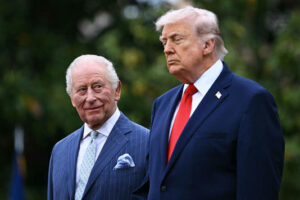
President Donald Trump walks with King Charles III during an arrival ceremony on the South Lawn of the White House on Tuesday. (Brendan Smialowski / AFP via Getty Images)
A toast, a bell and a few well-placed punchlines.
King Charles III is heading to New York from Washington on Wednesday, leaving a trail of raised eyebrows and knowing laughs.
Between quips about history and plenty of praise for America’s place in the world, the British monarch’s speech to Congress on Tuesday paired levity with pointed reminders of alliances, obligations and shared values — soft-edged rebuttals to some of the very positions aired by President Donald Trump.
With the relationship between the Unites States and the United Kingdom fraying, Charles used humor and history to try to steady the alliance, while quietly pushing back and making the case that, disagreements and all, the “special” relationship still has work to do.
Support for NATO, inclusivity and the “defense of Ukraine and her most courageous people” each featured in a series of indirect rejoinders to Trump in his speech.
Charles’ political speeches are written by the government, although Buckingham Palace aides have told NBC News that the tone and language were most likely his.
Charles’ most pointed comments come at a moment when American-British relations are arguably at their lowest point in decades over the Iran war, Trump’s disagreements with NATO and his criticism of Britain’s immigration policies.
While granting U.S. forces the use of British bases, Prime Minister Keir Starmer has denied Trump’s calls for the U.K. to be more actively involved in the Iran war. Those tensions hit a new high when Reuters published an internal Defense Department email last week that proposed punishing Britain for its position on Iran by reviewing America’s position on the Falkland Islands. NBC News has not reviewed the email.
But Charles said the alliance was “truly unique,” and “more important today than it has ever been,” while praising U.S. forces and allies “at the heart of NATO,” which keeps “North Americans and Europeans safe from our common adversaries.”
Later that evening at a state dinner, Charles broadened his remarks beyond the alliance to constitutional and environmental themes, including references to executive power being “subject to checks and balances,” delivered amid a war not approved by Congress, and to “the disastrously melting icecaps of the Arctic.” Trump, his host, is a climate-change skeptic.
“America’s words carry weight and meaning, as they have since independence, the actions of this great nation matter even more,” Charles said, closing out his speech to Congress with a comment that comes as Trump’s unique and no-holds-barred approach distresses longtime international allies and upends norms and long-term agreements.
At times understated, at others more pointed, the speech appeared to land well in the room, drawing many standing ovations.
Trump was full of praise for the king at the dinner.
In one apparently unscripted remark, Trump referred to Iran and said “Charles agrees with me even more than I do, we’re never going to let that opponent have a nuclear weapon.”
British monarchs are subject to rules and norms meant to prevent them from taking overtly political stands. Asked about Trump’s comments about Iran, a palace spokesperson told NBC News: “The king is naturally mindful of his government’s long-standing and well-known position on the prevention of nuclear proliferation.’
Speaking at the state dinner, Charles remained jovial, continuing with jokes about the two countries’ shared language and history, including a quip about the White House. He also turned to more serious matters, particularly the war in Ukraine again, invoking historic U.S. support where it is now seen as wavering.
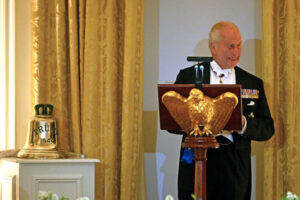
King Charles presents a bell from the HMS Trump, a submarine launched in 1944 during World War II. (Samir Hussein / WireImage)
The U.S. has ceased direct military support for Ukraine under the Trump administration but continues to provide intelligence that helps Ukraine defend itself and strike Russian targets. Trump has also pressured Ukraine to come to an agreement with Russia.
Charles also invoked America’s help in rebuilding a shattered European continent after World War II.
“I shall never forget that, not least as freedom is again under attack following Russia’s invasion of Ukraine,” he said, echoing remarks he made earlier to Congress. Ukrainian President Volodymyr Zelenskyy later thanked Charles for his comments.
Presenting Trump at dinner with the original bell from a British submarine that he said was launched from a U.K. shipyard in 1944, called the H.M.S. Trump, Charles’ rounded off his charm offensive.
It was this statesmanship, alongside his unique global position, that allowed him to indirectly criticize Trump, said Michael Bociurkiw, a nonresident senior fellow at the Atlantic Council’s Eurasia Center.
“Charles is the only world figure that could come at this very turbulent time, into the White House, and politely say what needs to be said in a way that doesn’t offend,” he told NBC News.
But Bociurkiw was unconvinced the message would stick.
“Sadly, it will be forgotten tomorrow,” he said.
The tone will shift more sharply Wednesday as Charles heads to the 9/11 memorial, where the mood of carefully calibrated humor in Washington is expected to give way to reflection.
That thread is likely to carry through to his meeting with New York City Mayor Zohran Mamdani, a visit with an emphasis on unity across religions and cultures.
“I am inspired by the profound respect that develops as people of different faiths grow in their understanding of each other,” Charles told Congress.
Whether his messages endure beyond the applause is another question entirely.
Courtesy/Source: This article was originally published on NBC News