
























































































MAY 11, 2026
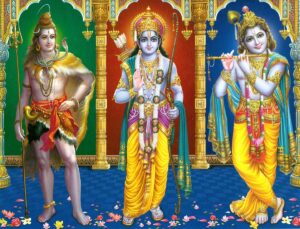
The Ramayana and the Mahabharata are often seen as two separate epics, but many Hindu traditions and scholars believe they are deeply connected through the larger idea of dharma, divine strategy, and the recurring struggle between righteousness and ego.
At the center of this connection stands Lord Krishna, the guiding force of the Mahabharata war, who is widely regarded as an avatar of Lord Vishnu just like Lord Rama from the Ramayana.
Although Krishna and Rama lived in different yugas and followed different approaches, many interpretations suggest that the lessons of the Ramayana shaped the way Krishna approached the Mahabharata war.
Rama represented ideal righteousness through strict adherence to duty, while Krishna represented practical righteousness in a morally complex age. Together, they reveal how dharma evolved across time.
This deeper connection between the two epics has fascinated devotees and scholars for centuries.
1. Krishna Understood That Dharma Alone Does Not Always Defeat Adharma
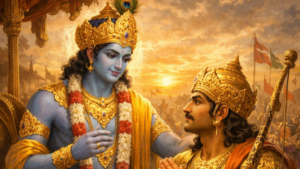
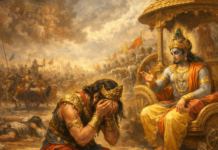
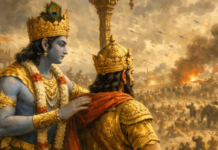
Lord Krishna With Arjuna (Image Credit: AI)
One of the biggest lessons often associated with the Ramayana is that even the most righteous individuals must face immense suffering before victory arrives.
Lord Rama followed dharma with unwavering discipline, yet he still experienced exile, separation from Sita, and a devastating war against Ravana.
In the Mahabharata, Krishna appears to recognize that the age had changed. The world of the Mahabharata was morally more complicated than the world of the Ramayana.
Deception, political manipulation, and broken ethics had become deeply embedded in society. This is why Krishna did not always insist on idealistic methods. Instead, he focused on preserving dharma through practical strategy.
Many scholars interpret this as a shift from Rama’s “ideal dharma” to Krishna’s “strategic dharma.”
2. The Fall of Ravana and Duryodhana Revealed the Same Weakness
Another powerful parallel between the two epics lies in the personalities of Ravana and Duryodhana. Both were intelligent, powerful rulers driven by ego and attachment to power.
Ravana ignored wise counsel from Vibhishana, just as Duryodhana repeatedly ignored advice from Bhishma, Vidura, and even Krishna himself. In both stories, arrogance becomes the central reason for destruction.
Krishna appears to understand this deeply during the Mahabharata war. Instead of merely defeating Duryodhana physically, Krishna systematically exposes the ego, greed, and injustice that had corrupted the Kaurava kingdom.
This reflects one of the core lessons visible in the Ramayana: no kingdom, however powerful, can survive when ego becomes greater than dharma.
3. Hanuman Became the Living Bridge Between Both Epics
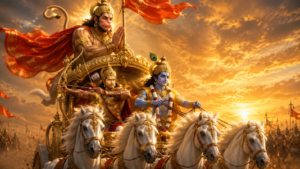
Lord Krishna, Hanuman Ji and Arjuna (Image Credit: AI)
One of the clearest symbolic links between the Ramayana and Mahabharata is Hanuman himself.
In the Mahabharata, Hanuman appears before Bhima and later remains on Arjuna’s chariot flag during the Kurukshetra war. This connection is deeply symbolic.
Hanuman represents unwavering devotion, humility, courage, and service to dharma. By placing Hanuman on Arjuna’s chariot, Krishna was not simply invoking protection.
Many traditions interpret this as Krishna carrying forward the spiritual strength and moral lessons of the Ramayana into the Mahabharata.
Hanuman’s presence also reminded the Pandavas that physical strength alone cannot win wars. Inner discipline and devotion matter equally.
4. Krishna Avoided the Mistakes That Led to Greater Suffering in Ramayana
Some interpretations suggest that Krishna’s strategic nature reflects an awareness of how prolonged conflict and strict idealism can create additional suffering.
In the Ramayana, Rama consistently followed the path of ideal conduct even when it caused personal pain.
In contrast, Krishna often chose faster and more practical solutions during the Mahabharata war.
For example, Krishna encouraged tactics that bent conventional warfare rules in order to stop warriors like Bhishma, Drona, Karna, and Duryodhana.
These actions remain debated even today, but many philosophical interpretations argue that Krishna believed preserving dharma for society was more important than maintaining perfect battlefield etiquette.
This creates one of the deepest contrasts between Rama and Krishna. Rama embodied perfect personal conduct, while Krishna embodied adaptive wisdom in a declining age.
5. Both Epics Teach That Dharma Changes With Time
One of the most profound lessons connecting the Ramayana and Mahabharata is the idea that dharma is not always expressed in the same way across different eras.
Rama’s life in the Treta Yuga reflected a world where moral order was still relatively stable. Krishna’s world in the Dvapara Yuga was more politically fragmented and ethically uncertain.
Because of this, Krishna’s methods during the Mahabharata war often appear more complex and strategic than Rama’s actions in the Ramayana. Yet both avatars ultimately worked toward the same goal: protecting dharma and restoring balance.
This is why many scholars and spiritual teachers view Rama and Krishna not as opposites, but as two different expressions of divine wisdom suited for different ages.
6. The Emotional Lessons of Ramayana Also Shaped the Mahabharata
The Ramayana is deeply emotional at its core. Themes of loyalty, sacrifice, grief, exile, and devotion dominate the epic.
These emotional lessons also echo throughout the Mahabharata. Krishna understood human weakness, grief, and attachment more deeply than most characters in the Mahabharata.
His guidance to Arjuna in the Bhagavad Gita reflects emotional wisdom as much as spiritual philosophy.
Many interpretations suggest that Krishna’s ability to guide emotionally broken individuals came from the broader Vishnu tradition that connected both epics.
The compassion seen in Rama and the wisdom seen in Krishna become part of the same divine continuity.
Conclusion
The Ramayana and Mahabharata are not isolated stories. They are deeply connected through recurring lessons about dharma, ego, devotion, leadership, and human weakness.
Lord Krishna’s role in the Mahabharata reflects many lessons that were already visible in the life of Lord Rama during the Ramayana. Where Rama represented ideal righteousness, Krishna represented practical wisdom in a more morally complex world.
Both avatars of Vishnu responded differently because the ages themselves were different. This is what makes the connection between the two epics so fascinating.
The Mahabharata did not abandon the lessons of the Ramayana. In many ways, Krishna transformed them for a changing world, ensuring that the fight for dharma could continue even in an age filled with confusion, ambition, and conflict.