



























































































APRIL 17, 2026
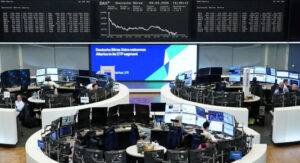
FILE PHOTO: The German share price index DAX graph is pictured at the stock exchange in Frankfurt, Germany, April 9, 2026. REUTERS/Staff/File Photo
LONDON – The price of oil tumbled and stocks and government bonds rallied on Friday after Iran’s foreign minister said that the Strait of Hormuz was open for passage while a ceasefire is in force.
Abbas Araqchi said in a post on X that passage for all commercial vessels through the Strait of Hormuz was declared completely open for the remaining period of ceasefire, in line with the ceasefire in Lebanon.
The price of benchmark Brent crude futures tumbled to $90 a barrel, down 9% on the day, U.S. crude fell 10% to $81.5 a barrel.
While still above pre-war levels, that is down significantly from late March’s highs, which, for Brent, were close to $120 a barrel.
Stocks around the world, which had already been trading around record highs, jumped further on the news. Europe’s broad STOXX 600 was last up 1.3% having been close to flat before the announcement, S&P futures were 0.9% higher.
“If we move to a situation where the path is still towards de-escalation – but we now have the bonus of commodity flows through Hormuz getting back to something resembling a normal level that we saw pre-conflict – then that’s obviously removing a pretty chunky tail risk for the economy,” said Michael Brown, senior research strategist at Pepperstone.
“I think that’s why markets are reacting so positively.”
Government bonds also rallied, with the benchmark 10-year Treasury yield dropping 7 basis points to 4.23%, its lowest since mid March.
Unlike stocks, which had already regained their pre-war highs in the United States and many other markets, bonds have yet to do so.
European bonds have sold off more than U.S. ones since the war began as the impact of higher energy prices had traders rushing in to price rate hikes from the European Central Bank and Bank of England.
On Friday they were outperforming as those rate cut bets were pared back.
Germany’s 10-year yield fell 8 basis points to 2.96%, while the rate sensitive two-year yield fell 10 bps to 2.42%. Britain’s two-year yield fell 15 bps to 4.10%.
The dollar also slid, falling 0.6% to 158 yen, while the euro was up 0.6% at $1.1848, a two-month high.
Courtesy/Source: Reuters