






























































































APRIL 14, 2026
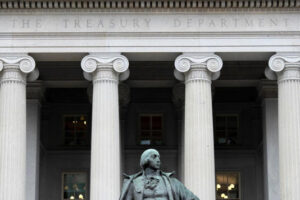
File photo: the Treasury Department building is seen, March 13, 2025, in Washington.
A Trump administration executive order that would require banks to collect citizenship information from customers is in “process,” U.S. Treasury Secretary Scott Bessent said Monday, as experts warn it could leave millions of Americans without access to a bank account.
In an interview at the Semafor World Economy’s inaugural Treasury Secretary Dinner at the Library of Congress, Bessent said he didn’t think the order would be “unreasonable.”
“Why don’t we have information on who’s in our banking system? I have a place in the U.K.; they want to know who lives in every apartment—and how do we know that it’s not part of a foreign terrorist organization?” he said.
White House spokesman Kush Desai has previously said: “Any reporting about potential policymaking that has not been officially announced by the White House is baseless speculation.”
Newsweek has contacted the Treasury Department via email for comment.
Why It Matters
President Donald Trump has pushed to cut back on the number of immigrants in the country illegally since his January 2025 inauguration.
Senator Tom Cotton, a Republican from Arkansas, has said he strongly supports the idea, and wrote to the Treasury Department, urging it to “undertake a comprehensive review of current rules that allow illegal aliens to obtain financial services and access to the U.S. banking system.”
“Access to the American banking system is a privilege that should be reserved for those who respect our laws and sovereignty,” he said. “When individuals are allowed to open accounts without verifying legal status, we are permitting illegal aliens to establish financial roots and integrate economically, all while bypassing the legal channels that millions use properly.”
However, banking experts have warned that this order would also affect a significant proportion of Trump’s own supporters, stripping Republicans of their banking accounts, while doing little to push the needle on money-laundering and fraud scams.
What the Executive Order Would Do
According to reports, the order would require banks to request various identification documents from customers who wish to maintain their accounts (which could be anything from passports to birth certificates) in order to check citizenship.
Reports state that this will apply to both new and existing customers, although the details of the order are not yet clear, such as exactly what documents will be needed, how banks will handle individuals with unclear or missing records, and whether exceptions would be allowed for vulnerable populations.
Who Would Be Most Affected
If implemented, the order could affect millions of Americans, such as those without passports or birth certificates, those missing documentation, elderly Americans born before standardized record-keeping, low-income individuals who rely on basic checking accounts, and people living in states with slow or costly document replacement processes.
The outlet American Banker has said that, as a result, Americans (even Trump’s own supporters) could be “debanked.”
Per the outlet, only half of the U.S. population own passports, with eight of 10 New Yorkers having one, but only two out of 10 West Virginians possessing one. In fact, the 10 states with the lowest passport rates (of 37 percent or below) voted for Trump in the last three elections.
American Banker also said that one in 10 Americans do not have their birth certificate handy, with nearly 4 million reporting theirs as lost, stolen or destroyed.
Students could also be affected, particularly those whose identification states their home address as different to that of their university housing.
How Other Countries Handle Bank Verification
Across much of the world, banks review a customer’s nationality as part of anti‑money‑laundering (AML) identity checks, typically using passports or national identity documents.
In the European Union, many member states require banks to collect and verify a customer’s nationality or nationalities under the bloc’s ALM framework. U.K. banks follow a similar approach, checking nationality through passports or approved ID under the Money Laundering Regulations.
Meanwhile, Singapore requires banks to record nationality as standard customer data and, for higher‑risk clients, to verify current and previous citizenships under Monetary Authority of Singapore guidance, while Canada and Australia similarly require banks to verify nationality using passports or citizenship documents.
In places such as Switzerland, Hong Kong, and the United Arab Emirates, banking rules list nationality or passport-verification as required identification data.