

























































































MAY 6, 2026
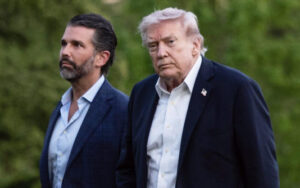
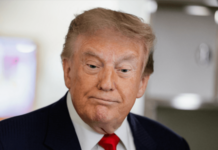
Donald Trump, pictured this week with with his son Donald Jr, has paused ‘Project Freedom’, leaving more than 1,500 ships stranded as doubts grow over his Iran deal claims – Anna Rose Layden/Getty
Pity the ship-owner or insurer with a tanker stranded in the Gulf. On Monday, Donald Trump offered a glimmer of hope by declaring that America would “guide” any trapped vessel through the Strait of Hormuz under “Project Freedom”. Now, barely 48 hours later, the president has suddenly “paused” this plan, even as more than 1,500 commercial ships still lie at anchor.
It is possible that Trump’s latest dizzying U-turn could be part of the diplomatic choreography before an impending deal with Iran. That is certainly what he would like us to believe.
On Tuesday night, Trump hailed “great progress” towards what he called a “complete and final agreement with representatives of Iran”. On this basis, he declared that Project Freedom “will be paused for a short period of time to see whether or not the agreement can be finalized and signed”.
But who would trust Trump’s announcements? More than two weeks have passed since he told CBS News on April 17 that Iran had “agreed to everything”. Just four days later, vice-president JD Vance abruptly cancelled his trip to Pakistan to meet Iran’s representatives because, in reality, they had barely agreed to anything.
Diplomats at summits are fond of saying: “Nothing is agreed until everything is agreed.” Trump’s brand of diplomacy turns this on its head by breezily declaring that everything is settled when, in fact, nothing has been resolved.
Even if the president is right this time and a US-Iran agreement is about to be announced, will it cover anything more than reopening the strait? What about Iran’s nuclear ambitions, particularly its 440kg of highly enriched uranium, and the regime’s surviving arsenal of ballistic missiles, along with its sponsorship of terrorism?
That leaves Trump with three options, all with huge disadvantages:
A quick deal to reopen the strait
Iran has already proposed a formula whereby free navigation would be restored in return for America lifting its blockade of Iranian ports and agreeing not to go back to war. But a quick deal may have no additional constraints on Iran’s nuclear programme, beyond recognizing the status quo, which is that no uranium enrichment is taking place. Other questions – missiles and terrorism – would not even be mentioned and any further nuclear limitations would simply be deferred until some future negotiation.
Advantages: Reopening the strait would lower oil prices and bring the global economy back from the brink. Trump would doubtless claim victory.
Disadvantages: By ending its embargo of Iran’s ports and ruling out military action, America would greatly reduce its leverage. A further deal on the nuclear issue and other bones of contention might either not happen or be far weaker than otherwise. Since Iran’s leaders would not concede when facing an embargo and constant air strikes, why would they yield if both pressures were lifted? Allowing Iran to agree to reopen the strait would implicitly concede the principle that its regime now controls this vital artery. Benjamin Netanyahu, the Israeli prime minister, would vociferously oppose any outcome along these lines.
Maintain the US embargo on Iranian ports and hold out for a comprehensive deal
Advantages: If successful, this approach would allow America not just to reopen the strait but to settle the nuclear issue and all other outstanding questions.
Disadvantages: In the meantime, the strait would stay closed, with the world economy heading for the brink. Iran may hang tough, refusing to yield to the blockade and rejecting a comprehensive deal on American terms. The regime might believe that, instead of watching the ruination of the global economy, Trump’s determination will crack first and he will fall back on option one above.
Go back to war
Advantages: Trump might seek to reopen the strait by force and impose his own terms for a comprehensive settlement on Iran’s regime.
Disadvantages: This would mean going back to war. Any operation to force open the strait would be fraught with risk and would almost certainly require American ground units. The strait would stay closed until any such venture succeeded, with disastrous consequences for energy supplies and the global economy. And, unless it is somehow overthrown, Iran’s hardline, military-dominated regime may still refuse America’s terms for a comprehensive deal.
So Trump has left himself with no good options. Faced with this extraordinary trilemma, the first option – a quick and partial deal – may prove irresistible.
Trump has finally realized he must seize the Strait of Hormuz
Courtesy/Source: The Telegraph