





















































































MAY 13, 2026
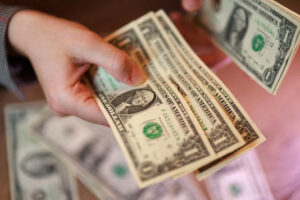
U.S. dollar banknotes are seen in this illustration taken March 24, 2026. – REUTERS/Dado Ruvic/Illustration
NEW YORK – The dollar gained on Wednesday after hitting a two-week high following the latest stronger-than-expected U.S. inflation reading, with talks set to begin in Beijing between President Donald Trump and China’s President Xi Jinping in the spotlight.
The U.S. Labor Department said the Producer Price Index for final demand surged 1.4% last month, the largest since March 2022 and well above the 0.5% estimate of economists polled by Reuters, after an upwardly revised 0.7% advance in March.
In the 12 months through April, the PPI jumped 6.0%, the largest increase since December 2022 and above the 4.9% forecast, after a revised 4.3% increase in March.
“That escalated quickly,” said Brian Jacobsen, chief economist at Annex Wealth Management in Menomonee Falls, Wisconsin. “With a 15.6% increase in the index for gasoline, it’s not too surprising that transportation and distribution costs have shot higher. For now, the energy shock is more a threat to corporate margins than to consumer prices, but the longer prices stay elevated, the more it will bleed through to the consumer.”
The dollar index, which measures the greenback against a basket of currencies, rose 0.21% to 98.53 after hitting 98.601, its highest level since April 30, with the euro down 0.26% at $1.1706.
The strong producer prices reading came a day after an annual reading of consumer prices posted its largest gain in three years.
In its mid-year outlook, Morgan Stanley said that it sees modest dollar weakness continuing through the second half of the year as “easing core inflation, lower rates and strong global risk appetite,” but also sees a recovery into 2027 as U.S. growth leadership and European political risks provide support.
Markets have largely priced out any chance of a rate cut this year from the Federal Reserve, while expectations for a hike of at least 25 basis points at the central bank’s December meeting have climbed to 35%, according to CME FedWatch, up from 16.3% a week ago.
The U.S. Senate confirmed Trump’s nominee Kevin Warsh as chair of the Federal Reserve, putting the 56-year-old lawyer and financier at the helm as the U.S. central bank grapples with intensifying inflation that may make it hard to push through the interest-rate cuts that the Republican president has demanded.
Boston Federal Reserve President Susan Collins said the central bank may need to raise interest rates if inflation pressures do not abate. Minneapolis Federal Reserve President Neel Kashkari said the labor market has improved from earlier this year while the Iran war has worsened inflation, supporting his view that rate hikes could be possible.
TRUMP ARRIVES IN BEIJING FOR XI SUMMIT
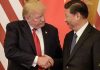
Trump and an entourage including Elon Musk and Nvidia’s Jensen Huang were greeted with a lavish welcome in Beijing on Wednesday as the president prepared to ask Xi to “open up” to U.S. business at the start of their two-day summit.
The Chinese yuan slipped 0.04% against the greenback to 6.787 per dollar after hitting 6.7852, its strongest level since February 2023.
Trump said he does not expect to need China’s help to end the war and Iran’s grip on the Strait of Hormuz, in remarks made before he arrived in Beijing. About a fifth of the world’s oil and liquefied natural gas ordinarily passes through the Strait of Hormuz.
U.S. crude fell 1.06% to $101.10 a barrel and Brent fell to $105.65 per barrel, down 1.97% as the possibility of Fed rate hikes grew, but held above the $100 level as a fragile ceasefire between the U.S. and Iran continued to hold, but the strait remains effectively shuttered.
YEN WEAKENS DESPITE INTERVENTION SPECULATION
The Japanese yen weakened 0.18% against the greenback to 157.88 per dollar. A sudden strengthening in the yen on Tuesday had stoked speculation of a “rate check” by authorities, which is often a precursor to a currency intervention.
Japan’s recent foreign exchange intervention may have kept the yen from sliding below the 160-per-dollar mark, but is unlikely to have a lasting effect, former Bank of Japan Governor Haruhiko Kuroda said.
Sterling weakened 0.17% to $1.3513 as Keir Starmer faced his biggest challenge yet when his health minister was reported to be readying his resignation to try to trigger a contest to replace the British prime minister, who had sought some respite to set out his government’s agenda.
Courtesy/Source: Reuters