



































































MARCH 23, 2026
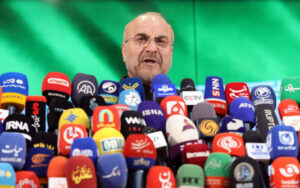
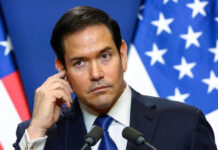
Mohammad Ghalibaf has denied Tehran is talking to America while reports name him as lead negotiator – Meghdad Madadi/Getty
The man whom Iran has entrusted to lead negotiations to end the war with the US has never shied away from doing the regime’s dirty work.
In 1999, as student protests broke out in Tehran against media censorship, Mohammad Bagher Ghalibaf got on to the back of a motorcycle, grabbed a club, and beat the demonstrators himself.
Maintaining order required someone willing to “be on the street with a stick in hand, even if that someone is a general”, he later boasted.
Now, Iran’s parliament speaker and former Revolutionary Guard commander faces a much bigger challenge.
Only on Sunday, Mr. Ghalibaf threatened to bomb anyone holding US treasury bonds, which he said were “soaked in the blood of Iranians”. “Purchase them, and you purchase a strike on your HQ and assets,” he said.
But hours later, he was reportedly having conversations with foreign intermediaries as Iran’s lead negotiator to end the war and save the Islamic Republic.
Of course, he has denied direct negotiations with America. “The fake news is used to manipulate the financial and oil markets and escape the quagmire in which the US and Israel are trapped,” he posted on X.
The paradox is the point.
Only someone who threatens to bomb US bondholders and publicly denies that talks are even taking place could sell a deal to hardliners in Tehran without it looking like a capitulation to America.
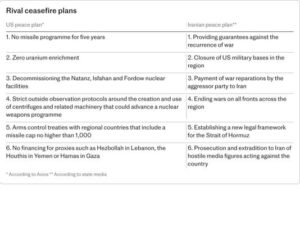
Rival peace plans
Iran needs to end this war. It has seen more than 1,400 civilians dead, its supreme leader killed, its military infrastructure devastated and its economy collapsing.
But the regime cannot survive being seen to surrender.
Mr. Ghalibaf solves that problem. In Iran’s view, when a diplomat negotiates, it’s appeasement, but when an IRGC general negotiates, it’s forcing America to the table.
Donald Trump said on Monday he was dealing with “a top person” who “is the most respected and the leader” given that “we’ve wiped out everybody.”
Mojtaba Khamenei, the supreme leader, is still out of the picture and Ali Larijani, the secretary of Tehran’s national security council, is dead.
Choosing Mr. Ghalibaf over Abbas Araghchi, the foreign minister, reveals everything about how the Islamic Republic understands its survival crisis.
Mr. Araghchi is Iran’s most experienced nuclear negotiator. He was in the talks that produced the 2015 agreement, knows American officials, understands Washington’s bureaucracy, and speaks their diplomatic language.
By any rational measure, he’s the obvious choice.
But rational measures don’t apply when a regime that has built nearly half a century of legitimacy on “Death to America” now needs to accept American terms.
Mr. Araghchi comes from the faction that hardliners view as treasonous. He sits with Hassan Rouhani, the former Iranian president, and Javad Zarif, his foreign minister: both reformists who believed engagement with Washington could work.
At the Quds Day rally on March 13, as hundreds of thousands demonstrated support for the Islamic Republic during wartime, someone in the crowd shouted “death to compromisers” when Mr. Araghchi was giving an interview – a direct reference to the Rouhani-Zarif-Araghchi diplomatic approach.
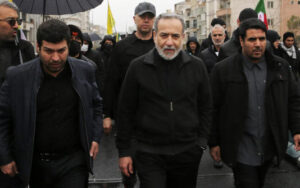
Abbas Araghchi (centre), Iran’s foreign minister, was labelled a ‘compromiser’ by hardliners during a Quds Day rally in Tehran – Fatemeh Bahrami/Anadolu
The Islamic Republic’s calculation is simple because it is better for Tehran to accept worse terms from Mr. Ghalibaf than better terms from Mr. Araghchi. After all, only Mr. Ghalibaf can frame those terms as victory.
Mr. Ghalibaf’s hardline credentials are unshakeable. He joined the Revolutionary Guards aged 20, in 1980.
By 22, he commanded a combat division fighting Iraqi aggression. He spent eight years in combat, leading the 25th Karbala Division.
After the war, he commanded the fearsome Basij paramilitary force, then led the IRGC’s air force, and at 39 became Iran’s police chief.
In 1999, as students protested across Tehran demanding reforms after the Salam newspaper was shut down, Mr. Ghalibaf led the crackdown himself.
He later boasted about “wielding sticks” against protesters, saying maintaining order required someone willing to “be on the street with a stick in hand, even if that someone is a general”.
In 1999, he co-authored an infamous letter from 24 IRGC commanders threatening Mohammad Khatami, the then president, if he didn’t crush the student protests.
Mr. Ghalibaf has said he and Qassim Soleimani – the Quds force leader killed by the US during Donald Trump’s first term – drafted the letter and collected signatures. The letter signaled the IRGC’s emergence as an explicit political actor, intervening directly to prevent reforms.
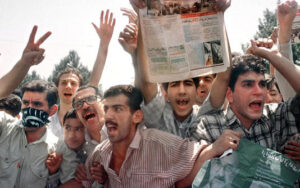
Mr. Ghalibaf personally led the crackdown on Iranian student protesters in 1999 – Henghameh Fahimi/EPA
Mr. Ghalibaf cannot be accused of insufficient commitment to revolutionary principles.
But there is another power dynamic which makes him the perfect choice inside Iran: his close relationship with Mojtaba Khamenei, the new supreme leader.
Khamenei has protected Mr Ghalibaf through multiple corruption scandals that should have ended his career.
In 2017, while mayor of Tehran, Mr. Ghalibaf was accused of selling 2,000 government-owned properties to friends and associates for discounts of up to 50 per cent.
He was further accused of embezzling £2.3bn in public money through transactions between the Tehran municipality and a front company linked to the IRGC.
In 2021, while he was speaker of the Iranian parliament, Mr. Ghalibaf’s wife, daughter, and son-in-law were pictured returning from a luxury shopping trip in Turkey with 294kg of luggage, while Iran was embroiled in economic turmoil and he was calling for “simple living”.
He allegedly transferred more than 70,000 sq metres of public land and provided thousands of pounds in municipal aid to the “Imam Reza Charity”, which is owned by Zahra Sadat Moshirand, his wife.
He was then accused of purchasing two flats in Istanbul for £1.2m. The nickname “corrupt commander” has followed him round for years.
But throughout it all, Mr. Ghalibaf was protected by the son of supreme leader Ali Khamenei and never charged with any wrongdoing. His subordinates served jail time.
This creates perfect conditions for negotiation. Mr. Ghalibaf cannot challenge Mojtaba Khamenei because he has saved his career multiple times.
He cannot use negotiations to build an independent power base because his power depends entirely on Khamenei’s protection.
For the new supreme leader, still not seen in public since the war began on Feb 28, Mr. Ghalibaf is the ideal negotiator.
Mr. Araghchi might negotiate better terms – sanctions relief, nuclear restrictions and regional de-escalation frameworks.
But better terms delivered by someone viewed as a traitor by the revolutionary core won’t save the regime.
For a system that built legitimacy on revolutionary ideology rather than government competence, perception matters more than substance.
Courtesy/Source: The Telegraph