



















































































MARCH 3, 2026
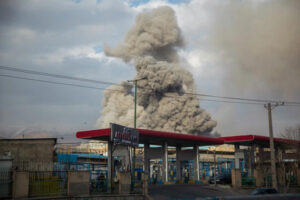
An explosion Monday in Tehran. – Majid Saeedi/Getty
There are countless ways the U.S. and Israeli attack on Iran could go wrong. Indeed, commentators seem to have dwelt on little else.
Instead, let’s game out everything going right, if only because that would be a game changer for world energy security and geopolitics.
If Iran, along with Venezuela, is soon ruled by a regime friendly or at least not hostile toward the U.S., that would neutralize two oil exporters who have regularly been the cause of supply disruptions in recent generations. Russia would remain the only adversarial oil power with significant sway, and its clout would be diminished.
This is a scenario, not a forecast. A range of outcomes is possible in coming days or weeks, and events in Iran remain fluid.
That said, they have so far gone well for the U.S. and Israel. They killed Iranian Supreme Leader Ayatollah Ali Khamenei on the first day, significantly degraded Iran’s military capabilities, and suffered limited retaliatory damage.
Iranian attacks have left gas facilities in Qatar and an oil refinery in Saudi Arabia damaged. Tanker traffic in the Strait of Hormuz has halted. But the strait technically remains open, and Iran’s ability to close it will likely diminish as the U.S. destroys its navy and missile batteries.
Market reaction so far suggests disruption has been less than feared. Since Friday, Brent crude oil is up about $10 to around $82 early Tuesday afternoon, at the low end of where many analysts had expected. U.S. stocks, which were little changed Monday, were down less than 1% Tuesday afternoon.
While President Trump initially called for regime change, he might stop short of that. After removing Venezuelan President Nicolás Maduro, Trump left Maduro’s vice president, Delcy Rodríguez, in charge, in exchange for control of its oil exports and industry.
An interim council now rules Iran while the country seeks a successor to Khamenei. Trump may conceivably let the regime stay in place if it meets his original conditions: an end to nuclear enrichment and ballistic missile development, and a halt to support for proxies such as the Houthis in Yemen and Hezbollah in Lebanon. The regime may conceivably see that as a less-bad option than a continuing air war and threat of domestic revolt. Agreement could pave the way for an end to sanctions.
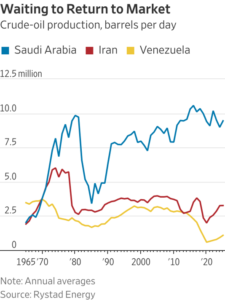
Waiting to Return to Market.
As with Venezuela, an end to sanctions would only gradually boost Iranian production, owing to decades of underinvestment. Its output would rise from its current 3.2 million barrels a day to 3.6 million by the end of next year, just below current capacity of 3.8 million, according to Rystad Energy.
In the long term, new supply could be significant. Iran’s proven reserves were the fourth-highest in the world in 2020, behind Venezuela, Saudi Arabia and Canada, according to the Energy Institute. Before the 1979 revolution, it produced 5 million to 6 million barrels a day. Its combined output with Venezuela equaled Saudi output.
As important as any new supply from Iran is the diminished threat of its abrupt withdrawal. Iran has been a near continuous source of disruption to oil markets, a history that runs from its 1979 revolution through its war with Iraq in the 1980s and to years of sanctions imposed because of its suspected pursuit of a nuclear weapon.
Venezuela has been another regular source of disrupted supply, from an oil strike in 2002 to the imposition of sanctions during Trump’s first term.
Without such threats to supply, the entire world will benefit from less volatility and a lower “geopolitical premium” embedded in oil’s price.
The economic benefit to the U.S. is likely to be slight. It is already a net petroleum exporter. Critical minerals and semiconductors are a greater source of American economic vulnerability than oil.
But if Trump succeeds in turning Venezuela and Iran from implacably hostile to at least neutral or even friendly regimes, the geopolitical benefit is enormous.
With Arab-Israeli relations slowly warming, albeit strained by Israel’s war in Gaza, a normalization of relations between Iran and the U.S. might mean the end of Middle East conflict as a constant threat to the global economy. Military assets devoted to the region could turn to the Indo-Pacific.
Venezuela, like Iran, had long destabilized its neighbors, supported hostile regimes, and was an important source of oil to China.
Both had been reliable allies to Russia in its continuing efforts to dilute American influence around the world. Russia now faces losing both, plus the prospect of their oil cutting into its sales. On the other hand, it might benefit from China’s loss of access to cheap, sanctioned oil, said Jorge León, head of geopolitical analysis at Rystad.
Obviously, this scenario glosses over extraordinary downside risks beyond the most obvious, such as the regime surviving the war without making concessions or being replaced by something worse, or none at all (i.e., civil war).
Even if the regime sues for peace, the U.S. may need an ongoing military commitment to ensure it complies with the terms. Similarly, keeping Venezuela’s new leader cooperative requires “an armada parked off her coast,” notes Kevin Book, head of research at ClearView Energy Partners.
One painful lesson from the past: The U.S. drove Iraq from Kuwait in 1991, then stopped short of regime change. Instead, it maintained sanctions and no-fly zones before concluding that only regime change would end Iraq’s threat to the region, and invaded. It is precisely the scenario Trump has sworn to avoid.
Courtesy/Source: The WSJ