






















































































APRIL 3, 2025
Tariff shock pummeling your 401(k)? Here’s what to do.
I will not tell you not to panic, because I’ve been screaming all day — and if I’m honest, tearing up.
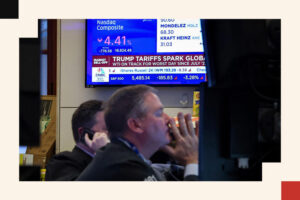
The stock market dove to heart-clutching territory after President Donald Trump announced sweeping tariffs on Wednesday that could start a trade war and possibly a punishing recession.
The Dow Jones Industrial Average dropped over 1,600 points, down almost 4 percent. The S&P 500 fell 4.8 percent, and the Nasdaq was down nearly 6 percent.
“For a president who used to use Wall Street as his own personal scorecard, today’s market assessment of his tariff plans has been damning,” Danni Hewson, head of financial analysis at AJ Bell, wrote in a midday report as major stock market indexes tumbled.
The markets hate uncertainty, and that is what Trump has brought. He promised tariffs, but the amount was larger than expected on top of ones already announced — 10 percent tariffs on all imports in addition to higher import taxes for about 60 countries.
The fallout has been swift, with trading partners promising to retaliate.
So here we are, regular investors without billionaire bank balances, trying to figure out how to save our savings.
Like many of you, I’ve gone without some things I wanted — for decades — so that I could put money in a 401(k). I understand how worrisome this is when you’re the first generation in your family to have money in the stock market. And like you, I have contemplated what should I do on a day like today.
Except for yelling, I don’t plan to change my investing strategy right now. In fact, I haven’t looked at my 401(k) since the markets began to skid in reaction to Trump’s tariffs.
Instead of pulling my retirement money out of the market, here’s what I did. I read back over the advice I’ve gotten from financial experts over the years during similar periods of market turmoil. It helped calm me down. Maybe it can help you, too.
Age-based advice
If you’re in your 20s, 30s, or early 40s, don’t let what’s happening now scare you away from the stock market. Keep investing.
As a young adult investor, you have available to you an important investing strategy that older investors don’t. You have time on your side. Consistently investing over a 30- or 40-year career can result in a seven-figure retirement account.
Likewise, if you’re 15 or 20 years away from retirement, stay the course. You still have a lot of years ahead if you plan to retire in your early or late 60s. And because you still have time, you don’t want to be too conservative and miss out on higher returns.
But for people near retirement or just retired, the recent market moves are understandably alarming.
Advice from Callie Cox, chief market strategist for Ritholtz Wealth Management, after the market fell on Trump’s first tariff announcement, still holds: Stay invested if you’re early in retirement.
Keep in mind, you still need to invest for growth. You might need to live off your savings for 20 or 30 years.
However, if you’re a retiree now tapping your 401(k) or similar retirement account, you might need to evaluate how much risk you can tolerate, many experts say.
“I like the idea of retirees holding seven to 10 years’ worth of portfolio withdrawals in a combination of cash and high-quality bonds to keep themselves from having to touch stocks when they’re down,” advises Christine Benz, director of personal finance and retirement planning for Morningstar.
Make sure you aren’t taking more risk than you can afford, in the words of Carolyn McClanahan, a certified financial planner based in Jacksonville, Florida.
Don’t look
Some things are better left unseen.
If you have a good long-term investment plan and you’re years away from having to tap your retirement funds, don’t keep checking on how the daily stock swings are affecting your retirement account.
Think of it like when riding a roller coaster if the drops are too scary: Close your eyes if you don’t want to see the fall. And remember that, eventually, the wild ride ends.
Put what’s happening in perspective
If you must peek, look at your overall returns for the last three, five and 10 years.
Year over year, the return on your retirement savings may be down, but what have your gains been like overall?
I’m not minimizing your concern, but as a long-term investor, you have to learn to stomach these storms.
In August, when the market took a nosedive, Dan Egan, vice president of behavioral finance and investing for Betterment, a digital investment advisory firm, reminded me: “Knee-jerk reactions to a fear of decline can cause more long-term damage than the decline itself.”
Cox also acknowledges that these are gut-wrenching market moves. But she reminds us that, for now, the turbulence is about tariffs, not economic fundamentals.
“Economic data shows we’re not in a crisis. At least not yet,” Cox wrote Thursday in market review. “Just because the stock market is down doesn’t necessarily mean you’re further away from your goals. Ups and downs are to be expected. Yes, even though they can hurt. The way to guard yourself against painful sell-offs is to ensure you can stay invested.”
Even during this tumultuous time, don’t make a financial move in a panic that you could regret later.
Courtesy/Source: Washington Post