




























































































APRIL 2, 2026
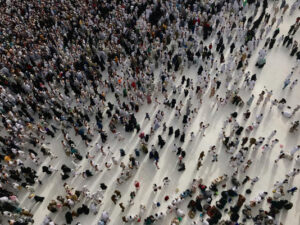
The global population is still rising, but the foot is off the pedal. – Image credit: Khawla Alrehaili/Unsplash – IFL Science
Earth is full. In fact, its sustainable carrying capacity was overshot decades ago. That’s the central message from a new scientific study finding that humans have pushed the planet far beyond its long-term limits. If we continue down this road of unfettered consumption, the paper warns that it will only intensify environmental and social problems for people worldwide.
Led by scientists at Flinders University, the study examined a vast body of data on the global population and resource consumption since the year 1000 CE.
This is what they found: In centuries gone by, the human population maintained an equilibrium with the planet. As the population steadily grew, so did demand for resources and energy, but technological innovation and natural replenishment kept pace. More people meant more innovation and technological development, which supported further expansion, and so on. It all worked like a self-perpetuating motor for growth.
However, that precious balance broke down in the 1950s following the Second World War and the rise of the “baby boomer” generation. By 1962, the world had entered a new era: the growth rate began consistently declining as the population increased.
“This shift marked the beginning of what we call ‘a negative demographic phase,” lead author Corey Bradshaw, Matthew Flinders Professor of Global Ecology from Flinders University, said in a statement.
“It means that adding more people no longer translates into faster growth,” he added.
Today’s population sits at around 8.3 billion, perhaps more, which is a marked increase from 7 billion in 2011. However, the rate of change has significantly slowed down since the 1960s, when it was at its highest.
The researchers from the new study believe the global population will peak in a few decades, perhaps in the late 2060s or 2070s, with somewhere between 11.7 and 12.4 billion people. After this, the global population will decline for the first time since the Black Death in the 14th century.
They added that Earth’s demographic conundrum has been largely “hidden” by our heavy reliance on fossil fuels, a finite resource that’s being exploited far faster than nature can replace it. Although gas and oil turbo-charged the world’s food production, energy supply, and industry, it was a short-term boom with no long-term plan.
Instead of hitting a wall when we ran short of food, energy, or materials, we were able to burn more oil and gas to keep the party going. The paper explains: “modern humans have essentially eradicated the limiting feedback from resource depletion via the exploitation of fossil fuels.” The natural check on our population didn’t kick in during the latter half of the 20th century thanks to fossil fuels, but the wells are starting to run dry, and the underlying problem is being revealed.
“The truly sustainable population is much lower and closer to what the world supported in the mid-twentieth century. Our calculations show a sustainable global population closer to about 2.5 billion people if everyone were to live within ecological limits and comfortable, economically secure living standards,” Professor Bradshaw said.
“Humanity’s current path will push societies into deeper crises unless we make major changes. The planet’s life support systems are already under strain and without rapid shifts in how we use energy, land, and food, billions of people will face increasing instability. Our study shows these limits are not theoretical but unfolding right now,” he added.
It’s worth noting that not all researchers agree with these figures — some estimates put Earth’s carrying capacity considerably higher than 2.5 billion, while others say the population will reach around 10 billion at a push.
Conspiracy theorists can relax, though. The study does not make the case for a global cull or a misanthropic population control programme. Other scientific groups have previously pointed out that these measures are often futile, clumsy, and harmful, especially when laced with eugenicist ideologies or deep-seated prejudices.
With that said, the researchers argue that the findings should prompt a serious rethinking of how we use land, water, energy, and materials for future generations.
“The choices we make over the coming decades will determine the wellbeing of future generations and the resilience of the natural world that supports all life,” concluded Professor Bradshaw.
The study is published in the journal Environmental Research Letters.
Courtesy/Source: IFL Science