


































































AUGUST 15, 2026
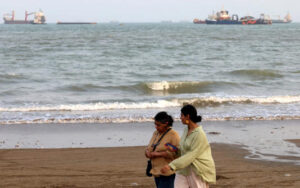
Iran’s judiciary chief has declared that the Strait of Hormuz is an ‘inseparable’ part of Iran – Atta Kenare/AFP
Iran has demanded that Donald Trump accept defeat in the Middle East.
Responding to the US president’s assertion that the Strait of Hormuz would soon be declared US territory, Kazem Gharibabadi, Iran’s deputy foreign minister, said the vital oil-shipping route would remain under Iranian control.
“The strait will be closed and opened only under Iran’s command, and as long as you do not accept the reality of defeat and cease indulging in fantasies, Iran will continue to enforce the blockade,” Mr Gharibabadi wrote on X.
“Once and for all, accept the reality: Up to this point, you have suffered strategic and heavy defeats; the Strait of Hormuz has been Iranian, and will remain Iranian.”
Iranian state media carried similar remarks made by Gholam-Hossein Mohseni-Eje’i, the country’s judiciary chief, who called Mr. Trump a “full[y] fledged loser in the hard arena of politics and military combat”, reiterating that the Strait of Hormuz remained “an inseparable part” of Iran.
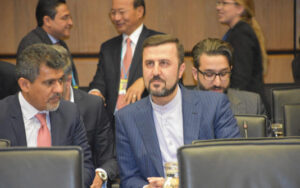
“What multibillion-dollar aircraft carriers could not achieve will not be achieved with a few tweets and speeches,” he said.
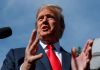
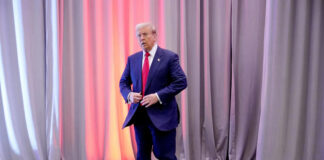
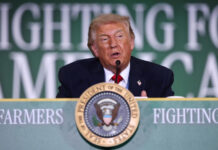
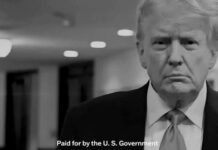
Meanwhile, at a political rally in New York on Saturday, Mr Trump said: “After we finish defeating Iran … pretty soon I’ll be declaring the Hormuz strait a territory of the United States.”
He also suggested that Americans should be willing to endure higher petrol prices while the conflict with Iran continued. Paying “a tiny little bit more for your gasoline” was worth it, he argued, to ensure that “a very evil country” could not have a nuclear weapon.
The war of words underscored the impasse between the United States and Iran, as talks to end the war and the blockade of the strait remained stalled.
At the same time, another Middle East truce – between Israel and Iran-backed Hezbollah – was hanging by a thread on Saturday, after Israeli air strikes killed 11 people overnight, including three children. The strikes were among the deadliest since a separate, tenuous pact was agreed in June.
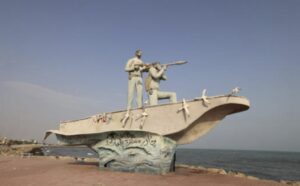
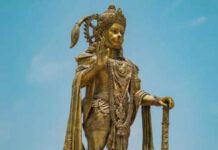
A sculpture overlooking the Strait of Hormuz in the port city of Bandar Abbas in southern Iran. Talks to end the blockade of the strait remain stalled – Atta Kenare/AFP
Deadlock has continued even as the US and Iran have each felt the effects on their domestic economy, with the potential for increasing public backlash.
For Americans, the war has meant high prices at the fuel pump, while in Iran, the blockade has caused inflation to soar, meaning that families are less and less able to afford staples such as oil and bread.
But there’s little sign that either side will be prepared to compromise, or even sit at the same negotiating table. Abbas Araghchi, Iran’s foreign minister, told Iranian media that Tehran would not resume talks with the US until Washington met certain conditions.
Iran has demanded that the US pay war reparations as a precondition for an end to hostilities and the reopening of the Strait of Hormuz, with a government spokesman estimating the losses at $270bn (£200bn).
Other demands included ending the US naval blockade, lifting economic sanctions, withdrawing US troops from the region, and releasing frozen Iranian assets.
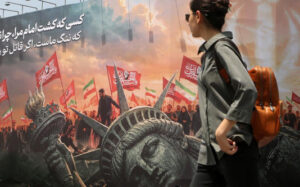
A poster in Tehran shows a fallen Statue of Liberty as tensions continue between the US and Iran – Anadolu
In response, Trump has called on Iran to pay compensation for the deaths of US soldiers, and threatened to impose an “indefinite” naval blockade in the Strait of Hormuz.
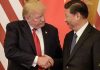
Alicia Kearns, the shadow minister for national security, warned that the United States needed to rethink its approach to the conflict, given that Iran has the support of such a powerful country as China.
“The US [is] essentially saying, ‘We are here for a war of attrition,’” she told The Telegraph. But “this isn’t Iran versus the US – this is Iran and China versus the US, and that should be changing their calculations quite significantly. We know that if [Iran] didn’t have China, they wouldn’t still be holding out.”
China has previously thrown Tehran an economic lifeline, helping it to weather crippling sanctions even before the current war began in late February. For instance, according to Kpler, an analytics firm, Beijing purchased more than 80 per cent of Iran’s oil exports last year – making it Tehran’s biggest buyer – despite global sanctions.
There is little sign that either side will be prepared to compromise in order to bring the conflict to an end – Atta Kenare/AFP
In addition, China has for years exported chemical precursors such as sodium perchlorate, which Iran can use to make ballistic missiles, prompting further sanctions. Such shipments are believed to have continued after war broke out in February, according to a Telegraph analysis.
As the conflict drags on, it has also emerged that Chinese satellite firms are likely to have provided intelligence to Iran, aiding its ability to surveil and target US assets in the Middle East. Ms Kearns has called on the UK to sanction the relevant Chinese organisations.
Also on Saturday, Iranian authorities called for the release of three pilots they said had been captured in Qatar during the conflict.
According to the Fars news agency, Gen Mohammad Bagherzadeh of the Iranian armed forces said: “Three Iranian pilots were captured alive by Qatari forces after their Su-24 fighter jets crashed during the war.”
Iran had previously said that the pilots were missing, but news of their alleged capture was not made public at the time.
Courtesy: The Telegraph