







































































JULY 13, 2026
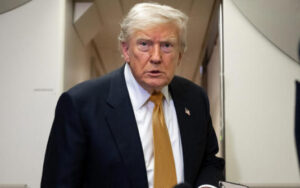
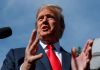
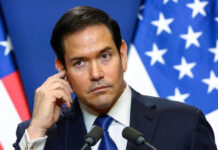
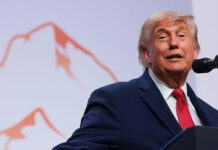
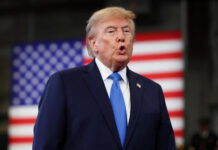
Donald Trump says US will be ‘guardian angel’ of the strait – Saul Loeb/AFP via Getty
The US has launched another wave of strikes on Iran hours after Donald Trump said he will impose a 20 per cent toll on all ships passing through the Strait of Hormuz.
US Central Command (Centcom) announced on Monday evening that it had begun a third consecutive night of strikes on Iran.
Centcom vowed on X to impose “a heavy cost on Iranian forces and degrade their ability to attack innocent civilians and commercial shipping in the Strait of Hormuz”.
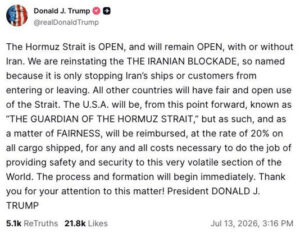
It came after the US president said the “process and formation” of the new fee in the contested strait will begin with immediate effect.
“The USA will be, from this point forward, known as ‘THE GUARDIAN OF THE HORMUZ STRAIT’, but as such, and as a matter of FAIRNESS, will be reimbursed, at the rate of 20 per cent on all cargo shipped, for any and all costs necessary to do the job of providing safety and security to this very volatile section of the world,” he said.
He had insisted earlier on Monday that the US would “keep the strait, and we’ll probably run it”, adding: “Maybe we’ll call it the guardian angel of the strait. And we should be reimbursed for that.”
Later, Trump said he expected the war with Iran to end with the US in control of the Strait of Hormuz.
“We’re attacking them tonight and we’re taking out all of their capability for anything having to do with the strait,” he told reporters in the White House.
“I think in the end we will end up just controlling the whole thing.”
Tensions between the US and Iran continue to fray following a weekend of tit-for-tat strikes that effectively shredded a tentative ceasefire agreement.
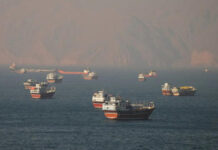
The Strait of Hormuz remains the principal stumbling block as both sides seek control of the waterway, through which a fifth of the world’s oil passed before the conflict began on Feb 28.
“We’re going to guard it. We’re going to get paid for guarding it – a lot of money,” Trump told Fox News on Monday.
The US military said the blockade stopping “maritime traffic entering and exiting Iranian ports” would resume at 4pm ET (9pm BST).
Iran said over the weekend that it had closed the Strait of Hormuz after it struck a container ship in the channel on Sunday, but the US insisted that Iran did not control the key waterway and that traffic continued to flow.
On Monday night, United Kingdom Maritime Trade Operations reported that a tanker had been struck by a projectile about 40 nautical miles off the coast of Qalhat, Oman.
Tehran also targeted US naval supplies and military bases in Jordan, Kuwait, Oman, Qatar and the United Arab Emirates, in its most extensive attacks on Arab states in the region since the signing of an interim peace agreement in June.
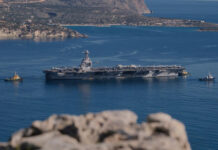
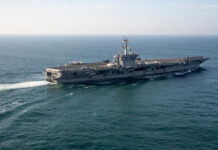
Iran’s Islamic Revolutionary Guard Corps claimed to have destroyed several key US facilities, including a refuelling station at the port of Duqm in Oman that they claimed was used to refuel the US aircraft carrier strike groups that have been central to Washington’s recent bombing campaign against Tehran.
The attacks prompted a furious response from regional capitals. Qatar described the strikes as a “dangerous escalation”. At the same time, Oman condemned attacks on its territory that came just hours after talks with Iran aimed at reducing tensions around the strait.
The Kuwaiti army also said a “hostile drone” attack on an offshore drilling platform had injured an employee.
It prompted significant retaliatory strikes by Washington, with the US military saying on Sunday that it had hit some 140 targets, including missile and drone launch sites, ammunition dumps and communication equipment.
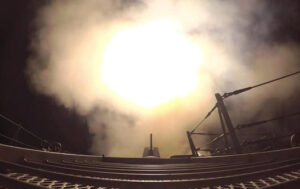
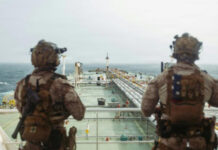
Video footage from US Central Command claims to show their forces striking Iranian military targets
The attacks were aimed at degrading the ability of Iranian forces to continue targeting commercial shipping in the crucial Gulf waterway. Trump said afterwards: “We’re beating them up.”
The latest flare-up will strain the ongoing negotiations between Washington and Tehran, which are nearly at the midpoint of the 60-day interim deal aimed at permanently ending the war.
On Monday, Iran’s foreign ministry said in a statement that the US attacks were “rendering futile all efforts made over the past several months to reduce tensions and restore stability”.
“The US regime has also caused the return of insecurity in the Strait of Hormuz and disruption of international commercial shipping by openly interfering in the process of Iran implementing the necessary arrangements in the strait,” it added.
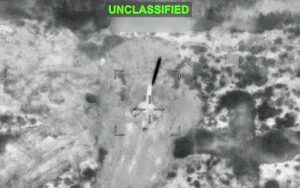
More footage released by Central Command purportedly shows US strikes against Iranian military installations on July 13.
Oil prices spiked after the weekend of renewed hostilities, with Brent crude, the international benchmark, rising 3.92 per cent to $78.99 (£59) a barrel, and US crude rising 3.44 per cent to $73.87 (£55) a barrel.
A small number of vessels appeared to be moving through the Strait of Hormuz on Monday, although traffic remained limited, according to data from the MarineTraffic website.
Pressed to clarify the status of the strait, Trump told NBC on Sunday that it was “open” to commercial traffic, but refused to provide further details.
US Central Command added that it was “prepared to ensure that freedom of navigation remains available to commercial shipping despite Iran’s continued unwarranted aggression, harassment, threats, and arbitrary declarations”.
Pakistan’s foreign minister called for “de-escalation” and urged all parties to the conflict to “show restraint” during a phone call with his Iranian counterpart on Sunday, according to a foreign ministry statement.
Courtesy: The Telegraph