



















































































JUNE 30, 2026
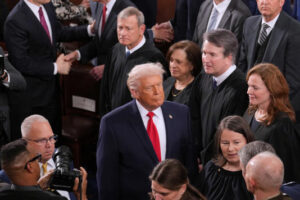
President Donald Trump walks past U.S. Supreme Court justices as he arrives on the House floor to give his State of the Union address to a joint session of Congress at the U.S. Capitol in Washington on February 24, 2026. (AP Photo/J. Scott Applewhite)
The U.S. Supreme Court dealt a decisive blow to President Donald Trump’s effort to restrict birthright citizenship on Tuesday, ruling that his executive order could not override the Constitution’s guarantee of citizenship to those born on U.S. soil.
The 6-3 decision in Trump v. Barbara, authored by Chief Justice John Roberts, marked a major check of presidential power and reaffirms long-standing interpretations of the 14th Amendment. It also has sweeping implications for immigration policy, affecting potentially hundreds of thousands of children born in the United States each year.
“Citizenship, then and now,” Roberts wrote, “was the right to have rights—to freely participate in our political community. The Framers of the Fourteenth Amendment extended that promise to ‘every free-born person in this land.’ We keep that promise today.”
Legal experts have said the ruling underscores that any fundamental change to citizenship rules would require a constitutional amendment, not executive action.
Trump had publicly signaled doubts about whether his push to restrict birthright citizenship would survive in court, at times acknowledging the legal headwinds his policy faces. In May, he said he would “probably” lose the case at the Supreme Court following a string of lower-court setbacks, while elsewhere warning justices would “find a way to come to the wrong conclusion” on the issue.
In response to a question ahead of the ruling, Trump told reporters in the Oval Office on Monday that he would “accept” any Supreme Court ruling but “No other nation does birthright citizenship [like America does it]. It’s tremendously destructive. It’s extremely costly. It’s up to them. But in terms of, for the good of the country, it would be great if they didn’t allow it.”
Donald Trump Reacts to Birthright Citizenship Ruling
Following the ruling, Trump called for legislation to address the birthright citizenship issue.
The president posted on Truth Social: “The Supreme Court upheld Birthright Citizenship, which is too bad for our Country, but we can easily make it up in Congress through Legislation, with the support of the President, that has now been determined during this process. No long and unwieldy Constitutional Amendment is necessary! Congress should start TODAY to work on ending expensive and unfair to our Country, Birthright Citizenship. They will have my Complete and Total Support!”
Critics of the current system, including the Trump administration, have long argued that foreign nationals exploit the Fourteenth Amendment through a commercialized “birth tourism” industry. They contend that wealth-driven agencies, particularly in China, systematically coach pregnant women to secure temporary visas so their children are born on U.S. soil and receive automatic American passports.
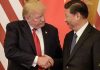
In a separate post, Trump sarcastically framed the outcome as a massive geopolitical victory for China, America’s primary global adversary.
“I would like to congratulate President Xi, and the Great Country of China, on their massive Birthright Citizenship WIN!”
Judicial Breakdown: Birthright Citizenship
The Supreme Court’s 194-page decision in Trump v. Barbara broke down into a 5-1-3 vote to affirm birthright citizenship under the 14th Amendment. Roberts, a conservative, authored the majority opinion, which was joined by liberal Justices Sonia Sotomayor, Elena Kagan and Ketanji Brown Jackson, though Jackson also penned a separate concurring opinion. Conservative Justice Amy Coney Barrett, appointed by Trump, also joined the majority opinion.
Conservative Justice Brett Kavanaugh, also appointed by Trump, took a unique middle ground, filing a separate opinion that concurred in the court’s overall judgment but dissented in part. The remaining three conservative justices disagreed with the core ruling. Justice Clarence Thomas authored a dissenting opinion that was joined by Justice Neil Gorsuch, while Justices Samuel Alito and Gorsuch also each wrote their own dissenting opinions.
“The Court today takes the extraordinary step of holding facially unconstitutional the President’s Order excluding from citizenship the children of foreign temporary visitors and illegal aliens,” Thomas wrote in a 91-page dissent. “In doing so, the Court adds to the sad history of the Fourteenth Amendment, which was designed and understood to secure equal rights for the freed blacks but has instead been repurposed for political projects that the Reconstruction Congress did not support.
“I am not sure that today’s opinion will stand the test of time. The Citizenship Clause ‘added greatly to the dignity and glory of American citizenship.’ Plessy, 163 U. S., at 555 (Harlan, J., dissenting). Today’s opinion devalues that citizenship. I respectfully dissent.”
Thomas’ dissent was more than three times as long as Roberts’ opinion for the majority.
Gorsuch drew a sharp line between “temporary visitors” like birth tourists, whom he would deny citizenship, and undocumented immigrants who have established permanent roots in the U.S. By arguing that the Fourteenth Amendment was intended to protect any child whose parents “have made this Nation their permanent home,” Gorsuch effectively aligned with the majority when it comes to the children of long-term undocumented residents.
In his dissent, Alito criticized the majority’s ruling as a “serious mistake” that misinterprets the Fourteenth Amendment to grant citizenship “on virtually everyone who happens to be born in this country.” Alito argued that the Citizenship Clause was never intended to confer automatic status on the children of “birth tourists” or undocumented immigrants. Instead, he maintained that the original constitutional meaning restricts automatic citizenship to children who, at birth, “owe allegiance solely to this country.”
What Is Trump v. Barbara?
Trump v. Barbara is a high-profile Supreme Court case challenging an executive order signed by Trump in January 2025 that sought to limit birthright citizenship. The order directed federal agencies not to recognize citizenship for certain children born in the United States if their parents lacked legal immigration status or held only temporary visas.
The case reached the Supreme Court after multiple lower courts blocked the policy, finding it likely unconstitutional. Plaintiffs—including immigrant families—argued that the order violated the post-Civil War 14th Amendment’s Citizenship Clause and federal law codified in the Immigration and Nationality Act.
At its core, the dispute centered on whether a president can reinterpret the Constitution’s guarantee of birthright citizenship through executive action. The administration argued that children of some noncitizens were not “subject to the jurisdiction” of the United States, while challengers said the order would overturn more than a century of legal precedent.
“That was meant for the babies of slaves. It wasn’t meant for people trying to scam the system and come into the country on a vacation,” Trump said in June 2025.
The president took the unusual step of attending Supreme Court oral arguments on April 1, in the case challenging his executive order. His appearance, widely described as a first for a sitting president, underscored the high political stakes of the case.
Trump sat in the public gallery while the justices heard arguments from the administration and challengers, listening silently as his solicitor general defended the policy. He left after the government’s presentation, and the court did not acknowledge his presence during the proceedings.
Republicans React to Birthright Citizenship Ruling
House Speaker Mike Johnson, reacting shortly after Tuesday’s ruling, said he needed time to review the full opinion but expressed disappointment with the outcome. The Louisiana Republican described the current interpretation of the 14th Amendment as a “textualist originalist” issue while arguing that the system has been widely abused in recent years through what he called “birth tourism.” Johnson suggested that achieving lasting change may now require a constitutional amendment—an outcome he noted is difficult, given it has been accomplished only 27 times in U.S. history.
Republican Representative Chip Roy of Texas was among the conservative lawmakers to sharply criticize the Supreme Court’s handling of birthright citizenship, arguing that the justices failed to uphold the Constitution, the rule of law and U.S. national security. He rejected the prevailing interpretation of the 14th Amendment, calling it unreasonable to treat birthright citizenship as an incentive for people to come to the United States to secure citizenship for their children.
Roy urged Congress to act immediately, saying lawmakers should clarify that being “subject to the jurisdiction” of the United States hinges on parental citizenship rather than place of birth. He also called for cutting off federal and state funding for any programs that grant legal status or documentation to individuals who do not meet that standard. Roy argued that Congress does not need a constitutional amendment to address the issue and warned that failing to act would represent a serious dereliction of duty.
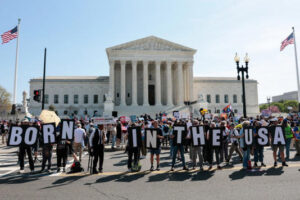
Demonstrators rally in support of birthright citizenship outside the U.S. Supreme Court in Washington on April 1, 2026. (Getty Images)
What Is Birthright Citizenship and Who Does It Apply to?
Birthright citizenship is the principle that anyone born in the United States is automatically a U.S. citizen at birth. The concept is rooted in the 14th Amendment, ratified in 1868, which states that all persons born or naturalized in the United States and subject to its jurisdiction are citizens.
For more than a century, courts have consistently interpreted the amendment to apply broadly, regardless of the immigration status of a child’s parents. The Supreme Court’s 1898 decision in United States v. Wong Kim Ark cemented that understanding, affirming that children born in the U.S. to immigrant parents are citizens.
There are only narrow exceptions, such as children born to foreign diplomats, who are not considered fully subject to U.S. jurisdiction. Otherwise, citizenship attaches automatically at birth, without requiring an application or government approval.
“Today, the Supreme Court upheld the Constitution’s guarantee of birthright citizenship and reaffirmed over a century of settled precedent on this issue,” Hispanic National Bar Association president Rosevelie Márquez Morales said in a statement shared with Newsweek. “The Fourteenth Amendment’s text is clear: all persons born or naturalized in the United States, and subject to the jurisdiction thereof, are citizens of the United States. No executive order can override this constitutional guarantee.
Global citizenship laws are starkly divided between jus soli (“right of the soil”) and jus sanguinis (“right of the blood”). Unrestricted birthright citizenship—where birth within a country’s borders guarantees citizenship—is largely a Western Hemisphere phenomenon, practiced by only about 33 of the world’s 195 nations, including the U.S., Canada, and most of Latin America. In contrast, Europe, Asia, and Africa overwhelmingly reject this, tying citizenship to ancestral bloodlines instead. Some developed nations like the UK, France, and Australia offer conditional birthright citizenship, requiring at least one parent to be a legal resident or citizen.
Over the past few decades, the global trend has actively moved away from unrestricted jus soli; nations like the UK (1983), Australia (1986), and Ireland (2005) all abolished automatic birthright policies to tighten immigration control.
What Has Donald Trump Said About Birthright Citizenship?
Trump has long argued that birthright citizenship should be restricted, describing it as a misinterpretation of the 14th Amendment. He has said the provision was intended primarily to grant citizenship to formerly enslaved people after the Civil War and not to apply broadly to children of noncitizens.
He has repeatedly pushed to end automatic citizenship for children born to undocumented immigrants or those in the country temporarily. His 2025 executive order reflected that view, proposing that at least one parent must be a U.S. citizen or lawful permanent resident for a child to qualify for citizenship at birth.
He has also warned that maintaining birthright citizenship places strain on government resources and encourages illegal immigration, while critics argue that his proposals conflict with clear constitutional language and long-standing precedent.
“Birthright Citizenship was not meant for people taking vacations to become permanent Citizens of the United States of America, and bringing their families with them, all the time laughing at the ‘SUCKERS’ that we are!” Trump wrote on Truth Social in May 2025. “The United States of America is the only Country in the World that does this, for what reason, nobody knows—But the drug cartels love it!
“We are, for the sake of being politically correct, a STUPID Country but, in actuality, this is the exact opposite of being politically correct, and it is yet another point that leads to the dysfunction of America.”
Courtesy: Newsweek