Recognize Your Battlefield
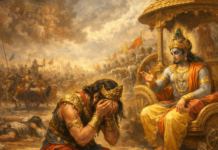
The first step is simple but rarely easy: know where the real fight lies. Your battles are not always loud. They can be the quiet war with someone’s constant criticism, the invisible pressure to meet expectations you never agreed to, or the inner conflict between staying safe and taking a risk.
Fight With Clarity, Not Ego
When the moment arrives that a confrontation is necessary, whether to defend your dignity, uphold truth, or honor a commitment, approach it deliberately:
- Act from duty, not emotion. The Gita calls this Karma Yoga, performing your role fully, without attachment to results.
- Detach from validation. Winning a fight may feel satisfying, but true victory lies in preserving your integrity and peace of mind.
- Courage is refined in calmness, not rage. The battles that matter require thought, presence, and self-mastery, not just force.
Fighting without clarity is like striking in the dark: you may win, but you lose yourself in the process.
Walking Away Is Strength, Not Surrender
There are moments when the hardest act of courage is not confrontation but letting go:
- Protect your energy. Life’s challenges are relentless; expending strength on battles that cannot change outcomes is self-defeating.
- Understand impermanence. People, circumstances, and opinions shift constantly. What weighs you down today may fade tomorrow, but only if you release it.
- Walk away without regret. Moving on is not denial; it is the conscious choice to prioritize your inner peace and growth over futile struggle.
This is not weakness. It is a higher understanding of when the fight is meaningful and when it is destructive.
Transforming Struggle Into Insight
The Gita does not promise an easy life. It promises awareness. Every struggle, every dilemma, every heartbreak is an opportunity to awaken to deeper truths:
Pain teaches discernment.
Conflict reveals your values.
Letting go nurtures resilience.
If approached consciously, daily challenges become teachers. Every choice to fight wisely or walk away gracefully shapes your character and brings clarity to your life.
The Quiet Revolution
The ultimate lesson is subtle yet profound: life’s victories are not always public or loud. Sometimes the real triumph is silent, internal, and invisible to the world.
To fight is to honor what is necessary.
To walk away is to honor yourself.
To see clearly is to transcend needless suffering.
This is the Gita’s timeless teaching: action without attachment, discernment without ego, presence without fear. If we can carry this into our daily lives, the storms may not stop, but our path through them becomes clear, our steps steady, and our spirit unshakable.