









































































NOVEMBER 3, 2026
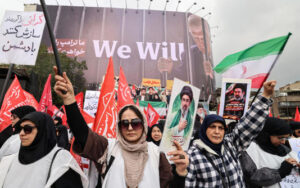
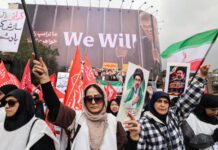
Iranians march in Tehran in front of an anti-US billboard – AFP via Getty Images/Atta Kenare
The US has launched secret strikes on Iran on the eve of the midterm elections.
Iranian state media reported five explosions on Qeshm Island, a strategic military site in the northern part of the Strait of Hormuz, which is home to an underground missile facility and naval base.
The surprise assault, which has been confirmed by US officials, followed Donald Trump repeatedly threatening to launch a new offensive against Iran while campaigning for the midterm vote.
The US has been carrying out a string of limited strikes on strategic targets in the Islamic Republic in recent weeks, despite claiming that a deal is within reach.
Officials told CNN that the strikes were defensive and intended to protect American assets in the region, with one source adding that the attack took place in response to Iran firing at a US aircraft.
The limited slew of strikes against Iran was designed to prevent attacks on ships in the Strait of Hormuz, sources also told The Wall Street Journal.
Trump sought to downplay the possibility of a return to all-out war with Iran on Monday.
“We had a war with Iran. We won,” the US president told reporters. “I don’t know if you even call it a war because we haven’t been doing any fighting for months.”
Trump acknowledged the strikes in a phone-in with Fox News. “They have no anti-aircraft,” he said.
“We took some out last night. Just a minor attack. It wasn’t war. They built an anti-aircraft facility. It took them about two months. We watched it get built. As soon as it was completed, we hit it last night.”
He later said he was not looking to “kill lots of people” in Iran after the midterms, as he claimed the US was “very strong right now”.
“Well, we’ll see,” he added. “Look, I’m not looking to, you know, kill lots of people, but if we have to, we’ll have to. But I’m not looking to do that. And we’re very strong right now.”
One official said the Trump administration had deliberately kept Monday’s attack secret to not exaggerate the defensive action and avoid the appearance of restarting large-scale operations.
Sources said there had been two encounters between US and Iranian forces in the Strait of Hormuz earlier on Monday, both of which were instigated by Iran.
In one instance, the Islamic Revolutionary Guard Corps (IRGC) fired a surface-to-air missile at a US fighter jet, which fired back. American forces also intercepted an IRGC missile originating from Qeshm Island that was targeting shipping.
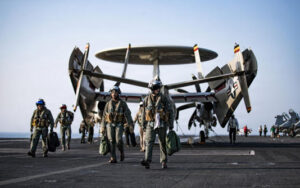
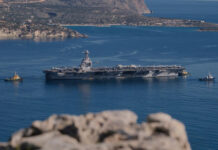
US sailors depart an E-2D Hawkeye on the flight deck of an aircraft carrier – AFP via Getty Images/US Navy
Unlike other strikes, the US has not made any public announcements about Monday’s military action or detailed the targets.
Four hours before reports of the strikes emerged, Trump claimed that oil prices were “dropping like a rock” because “people feel that there will not be a war with Iran”.
“Iran wants a settlement, as soon as possible. It could happen!” he added on his Truth Social platform.
Surging gas prices have loomed over the campaign for the midterms, in which the Republicans are set to take a beating from voters who have tired of a war that Trump claimed would last only six weeks.
Asked by reporters if he would strike Tehran after the midterms, the US president replied: “No.”
Senior members of the Trump administration were engaged in efforts to prevent a full-scale restart of combat operations as recently as last week.
JD Vance directly contacted a prominent Iranian hardliner to revive peace talks. In a letter to Mohsen Rezaei, the secretary of Iran’s Supreme National Security Council, the US vice-president reportedly laid out a framework for negotiations.
Trump directed Vance to send the note.
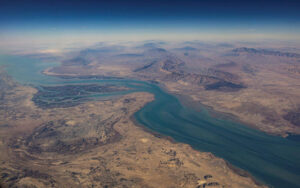
Qeshm Island is home to an underground missile site and naval base – Reuters/Nicolas Economou
“We’ve had a number of good conversations with the Iranians,” Vance told reporters when asked about the letter. “I actually just spoke with the president of the United States about an hour ago about this.
“The president and I both feel pretty good about the prospects for potentially coming to a negotiated settlement. We’re going to keep on working at it.”
But Esmail Baghaei, the spokesman for Iran’s foreign ministry, said “the ball is in the US court” to end the war, adding: “Our demands have been stated very clearly and transparently, and Iran’s demands are reasonable and logical.”
Iranian officials, including Mojtaba Khamenei, the supreme leader, have warned that Tehran would retaliate if the US resumed the conflict, potentially against American bases in Europe.
But following the strikes, Iran’s president Mazoud Pezeshkian said a return to war with the US would benefit “no one”.
While chief negotiator Mohammad Bagher Ghalibaf and deputy foreign minister Kazem Gharibabadi struck defiant tones – the former promising Tehran was “ready for battle with its finger on the trigger” – Mr. Pezeshkian said his government was still trying to resolve the crisis “through dialogue”.
The US has reportedly been restocking its munitions and moving troops away from vulnerable military installations in the Middle East.
Gulf states were told to prepare for a short and intense campaign against Iran after the midterms that would target infrastructure and nuclear sites, according to The Wall Street Journal.
On Saturday, Trump said the US still had to “take care of one or two” targets and threatened to hit Pickaxe Mountain, a fortified site linked to Tehran’s nuclear programme.
An Israeli spokesman said Israel was not involved in the strikes. On Tuesday, Trump announced an end to aid for Israel by the end of the year.
Courtesy: The Telegraph