

























































































MAY 28, 2026
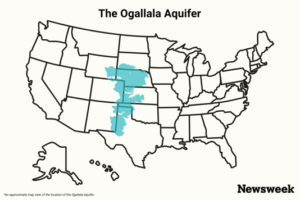
Ogallala Aquifer: The largest US groundwater supply is running out.
The largest underground water supply in the United States—responsible for sustaining a vast share of the nation’s farming—is steadily running dry, raising concerns about future food production and price volatility as supplies come under strain.
The Ogallala Aquifer, which lies beneath eight Great Plains states from South Dakota to Texas, provides roughly 30 percent of the groundwater used for irrigation in the U.S. and supports around a fifth of the country’s agricultural output.
But water levels have been falling for decades, raising fresh concerns about how long one of the world’s most important food-producing regions can continue to rely on it.
In some areas, groundwater levels have dropped by more than 200 feet since large-scale irrigation began, according to U.S. Geological Survey data—one of the clearest signs of long-term depletion. Satellite analyses have also shown widespread declines across the aquifer, with maps revealing concentrated losses in heavily irrigated parts of Texas and Kansas.
A NASA Earthdata analysis has mapped what researchers described as the “human footprint” on the aquifer, showing how widespread pumping for agriculture has reshaped groundwater levels across the region. The findings add to a growing body of evidence that the system is being depleted far faster than it can naturally recharge.
Why The Ogallala Matters
The Ogallala underpins farming across the Great Plains—one of the most productive agricultural regions in the world. Crops including corn, wheat and cotton, and livestock rearing, rely heavily on irrigation drawn from the aquifer.
But scientists say withdrawals continue to exceed recharge, meaning the aquifer is effectively being mined rather than replenished.
Recharge rates in much of the region are less than an inch per year, far below the volume being extracted for irrigation. NOAA has previously warned that the “Great Plains’ Ogallala Aquifer [is] drying out,” highlighting the widening gap between supply and demand.
That has implications not just for farmers but for food prices, rural economies and long-term water security in the U.S.
Chris Bowen, a postdoctoral researcher in agricultural water management at the University of Manchester, in the U.K., said the impacts are already becoming visible, particularly in areas where water use is highest and recharge is limited.
“It’s going to be gradual in terms of how fast water can be delivered to farmers,” Bowen told Newsweek. “As the water table drops, the availability per farmer—the rate they can get water onto fields—reduces.”
What the Research Shows
The Ogallala is often described as a “fossil” water source—formed thousands to millions of years ago—with a natural recharge rate of less than an inch per year in many areas.
That imbalance has driven long-term declines. U.S. Geological Survey data shows water levels in parts of the High Plains aquifer have dropped by more than 200 feet in some locations since large-scale irrigation began in the mid-20th century.
Climate pressures are expected to worsen the trend. The National Climate Assessment previously warned that drought and rising temperatures will likely increase water demand while reducing supply, intensifying stress on the aquifer.
The new NASA analysis underscores how human activity—not just climate—has reshaped the aquifer, with irrigation driving major changes to groundwater storage across the region.
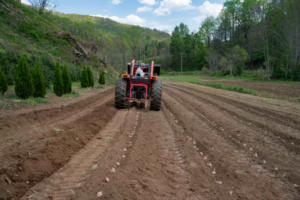
Paul Hodgson plants potatoes amid drought at Bluff View Farms on April 24, 2026 in West Jefferson, North Carolina.
What Happens If It Runs Dry
In some parts of the southern Ogallala, the future is already visible.
Studies suggest that up to 40 percent of the aquifer may no longer be able to support irrigated agriculture within decades, while broader projections indicate significant depletion over the next half-century.
If large areas become effectively dry, farmers could be forced to switch from irrigated crops to less water intensive farming—or abandon production altogether.
In practice, Bowen said the shift is more likely to happen incrementally, as farmers adjust how they use limited water supplies.
“They won’t try to spread less water across the same land—that’s not good for yields,” he said. “Instead, they shrink the area they irrigate, so more land becomes rain-fed while they maintain high yields on a smaller area.”
That trade-off, he added, means overall production still falls even if some fields remain highly productive.
Reduced irrigation could also make food prices more volatile as the loss of groundwater removes a key safeguard against drought.
“Irrigation is usually a buffer that prevents catastrophic crop losses,” Bowen said. “If that runs out, then shocks like drought hit much harder—and you’re more likely to see big price spikes from year to year.”
That could ripple beyond the Plains. Much of the corn grown in the region is used for livestock feed, meaning disruptions can feed through to meat and dairy prices and, ultimately, grocery bills.
What’s Next
Bowen explained that one of the core challenges is that groundwater use is difficult to measure accurately, meaning policies designed to limit extraction are often hard to enforce in practice.
Better monitoring of water use is increasingly seen as a key part of managing depletion, as experts say governments often lack reliable data on how much groundwater is being used at the farm level. Satellites can already capture images of farmland every few days, and machine learning models can be used to estimate how much irrigation is being applied across large regions.
Bowen said new technologies could help address that gap.
“One of the big challenges is that we don’t have good data on how much water is actually being used,” he said. “Even where policies are in place, it’s very difficult to enforce them without that visibility.”
He is currently working on a project using satellite imagery and artificial intelligence to map irrigation patterns, helping identify where water use is highest and where interventions could be most effective. While the work is focused on sub-Saharan Africa, he said the same approach could be applied globally, including in highly stressed systems like the Ogallala.
Courtesy/Source: Newsweek