


















































































AUGUST 11, 2026
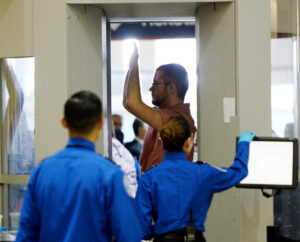
An airline passenger stands in a full-body scanner at Transportation Security Administration (TSA) checkpoint at Los Angeles International Airport, California February 20, 2014. U.S. authorities issued a warning on Wednesday to airlines flying to the United States to watch out for militants who may have hidden bombs in their shoes, U.S. government sources said. iREUTERS/Kevork Djansezian (UNITED STATES – Tags: POLITICS TRANSPORT SOCIETY)
Before any trip can truly begin, travelers and their baggage have to get through airport security.
Most people know to empty their water bottles because liquids over 3.4 ounces (or 100 milliliters) are prohibited, and that weapon-like or hazardous items are likely going to get flagged. But the list doesn’t end there, and having these prohibited items packed in your luggage can result in a massive penalty fee.
Some travelers may not realize that seemingly innocent household tools like cordless curling irons and sporting equipment are also banned – or that it’s allowed in a carry-on but not your checked luggage, and vice versa. Even power banks and any other devices with lithium-ion batteries must be in a carry-on due to risks of overheating.
“To avoid delays, always check TSA and airline rules before packing, keep your luggage organized, pack liquids and electronics separately for easy access, and make sure any items that could need extra screening are on top or in an easily accessible pocket,” Paul Stewart, travel expert and founder of My Baggage, told USA TODAY last November.
Here are three odd TSA rules travelers should know.
10 surprising banned items by TSA
Travelers can check out TSA’s website for a complete list of the banned items for carry-on and checked luggage. When an item is flagged, even if technically permitted, your suitcase may have to go through additional screening, so it’s best to do your research ahead of time. If you’re caught trying to bring a prohibited item through, you can face up to $17,062 in civil penalties per violation, per person.
Here are some items that are banned by TSA in some form that may be surprising to travelers.
- Cordless curling irons – banned in checked baggage
- Bowling balls – banned in carry-ons
- Cast iron cookware – banned in carry-ons
- Corkscrews with a blade – banned in carry-ons
- Electronic cigarettes and vaping devices – banned in checked luggage
- Foam toy sword – banned in carry-ons
- Gel-type candles – banned in carry-ons
- Samsung Galaxy Note 7 phones – banned in carry-ons and checked luggage
- Screwdrivers longer than seven inches – banned in carry-ons
- Snow globes – banned in carry-ons if containing over 3.4 ounces of liquid
Can I fly with breast milk or formula?
Yes. An exception to the 3.4-ounce rule applies to the smallest of travelers.
Formula, breast milk, toddler drinks, and baby or toddler food are allowed in your carry-on. That’s because these are considered to be medically necessary liquids, according to the TSA website. This includes the ice packs used to keep these liquids cool, even without the presence of breast milk.
Travelers should inform the TSA officer of the liquids and remove them from their carry-on to be screened separately. It also helps to store it in clear, translucent bottles.
Can I opt out of biometric screenings?
With biometrics more prevalent at U.S. airports, some travelers may not know that they can actually opt out of the scanning technology. TSA is legally required to respect any traveler’s decision to deny the facial recognition and full-body scanner, but the screening process could end up taking longer. TSA’s website states biometrics is only used for verifying identity and not for surveillance, and data is deleted by the Department of Homeland Security after 180 days.
The Transportation Security Administration did not immediately reply to USA TODAY’s request for comment.
Travelers can inform the TSA officer they don’t want to participate in the face scan and will go through the standard ID verification process instead. They can also deny the full-body scanner in place of a manual search, or “pat-down,” instead by an officer “of the same sex,” according to TSA’s website. Travelers with mobility issues or disabilities should inform the officers, in case they need a chair during the pat-down or have a medical device.
“A pat-down may include inspection of the head, neck, arms, torso, legs, and feet. This includes head coverings and sensitive areas such as breasts, groin, and the buttocks. You may be required to adjust clothing during the pat-down,” TSA states on its website. “The officer will advise you of the procedure to help you anticipate any actions before you feel them. Pat-downs require sufficient pressure to ensure detection, and areas may undergo a pat-down more than once for the TSA officer to confirm no threat items are detected.”
Keep in mind that those whose boarding pass shows they’ve been selected for enhanced screening may still be required to undergo the scan. TSA said this “will occur in a very limited number of circumstances.”
Courtesy: This article originally appeared on USA TODAY