





















































































APRIL 10, 2026
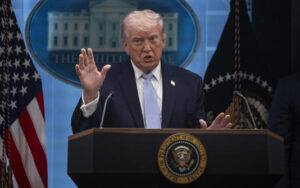
Donald Trump, whose war in the Gulf has led to the closure of the Strait of Hormuz, has been urged to counter the threats to routes in the Bering Strait – Getty Images
Donald Trump’s obsession with acquiring Greenland has blinded him to a security crisis brewing on his own doorstep, Arctic leaders have warned.
Ólafur Ragnar Grímsson, the former president of Iceland, said Mr Trump had been talking “utter rubbish” about enemy ships surrounding Greenland, while neglecting a very real Russian threat on his own side of the Arctic.
In an interview with The Telegraph, Mr. Grímsson urged the US president to look “closer to home” and counter a significant increase in Chinese and Russian ship activity around the Bering Strait, off the coast of Alaska.
Last week, the US and Denmark began secret talks on the future of Greenland, which Trump had threatened to conquer by force earlier this year.
After Trump attacked Venezuela, concerns over a potential invasion of the autonomous Danish territory were so acute that Denmark prepared to blow up Greenland’s runways to prevent US military planes from landing.
The two countries are now seeking a diplomatic solution, with Copenhagen stressing that it cannot give up sovereignty in any form. But the row over Greenland could come to the fore now the Trump administration has secured a ceasefire with Iran.
On Thursday, Trump wrote on social media that Greenland was a “big, poorly run piece of ice” and accused Nato countries of abandoning his country during the Iran war.
Mr. Grímsson, the chairman of Arctic Circle, an organisation that brings together top politicians and business leaders, said: “This whole discussion [by the Trump administration] about Russian and Chinese ships in the waters of Greenland is, to put it bluntly, utter rubbish.
“There is, however, a Chinese and Russian presence off the coast of Alaska. That is the only place they are. So I say to President Trump, the place to start is at home.”

Ólafur Ragnar Grímsson, the former president of Iceland, urged Mr Trump to ‘build up the necessary infrastructure in Alaska, which all the previous US administrations have neglected’ – Getty
Analysis by The Telegraph found that around two dozen Russian and Chinese aircraft and vessels, most of them military ships, have been tracked near Alaska by the US coast guard as potential security threats since 2023.
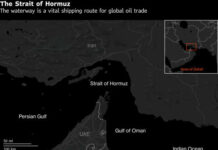
The warning comes amid a global crisis in shipping routes, with the Strait of Hormuz sealed off by Iran after Trump launched his Gulf war.
The Telegraph approached the White House for comment but did not receive a response.
Dan Sullivan, the Republican senator for Alaska, insisted the issue was being taken seriously by the Trump administration, but has also warned that more investment was needed to counter Russia and China.
He said in March: “We are now undergoing the largest military build-up and expansion, billions of dollars in investment in Alaska, since World War Two … my belief is we’re doing a lot, but we need to do more.”
At the height of the Greenland crisis, in which Mr Trump threatened a military takeover, he falsely claimed the Danish overseas territory was “covered with Russian and Chinese ships all over the place”.
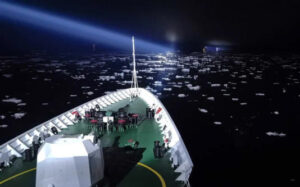
An image from the Chinese coastguard shows a joint China-Russia coastguard ship formation in an area of ocean with floating sea ice – Chinese coastguard.
Trump also excoriated Europe’s Nato members for not making enough effort to defend Greenland – a charge Mr. Grímsson said could also be applied to waters near Alaska.
The melting of ice caps in the Arctic has triggered a global scramble for influence over the far northern region, with the prospect of new shipping routes that could halve the sailing time from Europe to Asia.
Alaska is by the Bering Strait, the entranceway for the new Transpolar Sea Route, which is expected to fully open up to trade vessels in the 2040s or 2050s as Arctic ice melts because of climate change.
Once open, the Transpolar Sea Route is expected to take five days less to sail than the Northern Sea Route. It will be the shortest travel pathway between Asia and Europe, in a major shift for the global shipping industry.
Mr. Grímsson, who governed Iceland for 20 years, said it was therefore crucial that the West significantly built up its security presence around Alaska. Otherwise, it risked losing out to Russia and China, which were already launching joint military exercises and coastguard patrols in the area.
Mr. Grímsson said: “If you look at the globe from the top, you realise the Arctic is the neighborhood that links North America, Russia, and China together in a way that will have monumental consequences in the coming decade. It is becoming the centrepiece of a new geo-economic, geopolitical, geo-strategic framework of competition for the major powers.”
Comparing the importance of the Arctic’s new shipping routes to that of the Suez Canal, he added: “So he [Trump] should start at home. Build up the necessary infrastructure in Alaska, which all the previous US administrations have neglected. If you’re really concerned about Russian and Chinese presence in the Arctic, start building capabilities in the American Arctic.”
Mr. Grímsson said the US and Nato allies should have a frank discussion soon about the costs of securing the Arctic. He said it would be “extraordinarily expensive” and require submarines, icebreakers, surveillance systems and possibly missiles.
Activity near Alaska
The largest ship movement tracked since 2023 near Alaska occurred in August of that year, when a joint Chinese and Russian naval patrol of 11 ships passed near the strategically important Aleutian Islands.
The islands, which the US bought from Russia in the 19th century, serve as a staging area for defences against any future Russian, Chinese or North Korean missile attacks. US officials deemed it such a serious incident that four US destroyers and a surveillance aircraft were sent out to shadow the Chinese and Russian vessels.
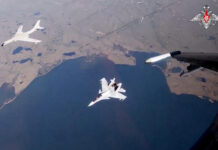
This was followed by a July 2024 incident, in which the US intercepted two Chinese Xian H-6K bomber jets and two Russian Tu-95MS Bear bomber jets near Alaska.
In October 2024, two Chinese coastguard ships and two Russian border service ships were monitored by the US coastguard as they sailed near St Lawrence Island in the Bering Sea. In August 2025, the US coastguard tracked two Chinese research vessels, Ji Di and the Zhong Shan Da Xue Ji Di, as they passed through the Bering Strait near Alaska.
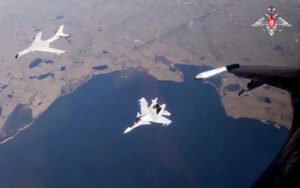
Russian and Chinese aircraft pictured over the Bering Sea in July 2024 – Getty
Since Trump launched his war on Iran, the North America Aerospace Defence Command (Norad) also reported a case on March 4 in which it tracked a Russian aircraft flying in Alaska’s Air Defense Identification Zone (ADIZ).
Norad added, however, that such activity “occurs regularly and is not seen as a threat”. ADIZs are regions of airspace where a country’s forces will identify, locate and control foreign aircraft to protect national security interests.
Ed Arnold, a senior research fellow at the Royal United Services Institute, agreed Washington risked neglecting the Alaskan side of the security situation in the Arctic.
He said: “If you want to have dominance over the western hemisphere, then that part of the coast off Alaska is critical, and they should be focusing more on those areas.
“On Arctic security, the United States has been more east-facing than west-facing, and looking west the threats, whether they be Russian or Chinese, will be coming through the Northern Sea Route or, as it were, from the other end of the tunnel.”
He said the West was facing a new era where control of shipping routes in the Arctic, Gulf and beyond would become critical to keeping its economies afloat. It could force Western leaders to weigh up the economic costs of military action against enemies much more carefully, Mr. Arnold said, now the closure of shipping channels – such as the Strait of Hormuz – was a real risk.
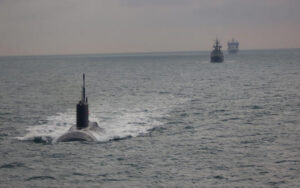
The Royal Navy shadowed a Russian submarine during a three-day operation in the Channel in December – MoD
Mr. Arnold added: “Security arguments look to the future, so they are more nebulous than economic arguments – when inflation is high, for example, people care less about Russia posing a threat.
“Global shipping is rising up the priority list, there has been much more of a focus on it in the last five years. We are going to see economic arguments trump the security arguments [against Russia and China], such as arguments based on a need for economic growth.”
At the same time, Mr. Arnold noted that Trump’s somewhat erratic behaviour on the Greenland issue had at least forced Europe to pay more attention to Arctic security, which it may not otherwise have done.
Trump threatens Greenland again after Rutte meeting
The Alaska threat has also caught the attention of the Arctic Institute, a Washington, DC-based think tank specialising in Arctic security, which warned in October that “Alaska, not Greenland, should worry the United States in the Arctic”.
Erdem Lamazhapov and Andreas Østhagen, two of the institute’s researchers, warned that the US was failing to counter Russian and Chinese activity in Alaska, and said its focus on Greenland was “misplaced”.
They cited China’s announcement last year that it would add a new icebreaker to its fleet, whereas the US coast guard’s Polar Security Cutter has been delayed until as late as 2030.
“Greenland is a distraction,” they concluded.
Courtesy/Source: The Telegraph