















































































JANUARY 28, 2026
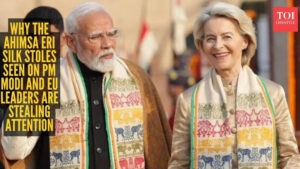
When Prime Minister Narendra Modi stood beside European Commission President Ursula von der Leyen to announce the India–EU Free Trade Agreement, it wasn’t just the deal that grabbed attention. What really made people pause was what they were wearing. Draped over both leaders’ shoulders was a simple, elegant stole from India’s Northeast – understated, yes, but packed with meaning.
After nearly 18 years of back-and-forth, the trade agreement is being called one of India’s most important global partnerships. Ursula von der Leyen summed it up in an X post, calling it the “mother of all deals” and pointing to a new free trade zone connecting almost two billion people. But while policy headlines did their rounds, social media zoomed in on something else entirely: those matching Eri silk stoles.
A Republic Day gift with deep roots
The stoles weren’t a random styling choice. They were part of India’s Republic Day 2026 invitation extended to Ursula von der Leyen and European Council President António Costa. The idea was simple but thoughtful – spotlight the living craft traditions of the Northeast.
The design honoured the Ashtalakshmi states – Arunachal Pradesh, Assam, Manipur, Meghalaya, Mizoram, Nagaland, Tripura and Sikkim, and the artisans who keep these traditions alive. During the 77th Republic Day celebrations, several ministers and visiting dignitaries were seen wearing the same stole, quietly reinforcing that India’s global image today isn’t just about power and policy, but also about culture and craft.
So, what exactly is Eri silk?
Eri silk isn’t your typical glossy, high-shine silk. It’s softer, warmer and far more grounded. It carries a Geographical Indication (GI) tag and is often called an “Ahimsa silk” – because no silkworm is killed in the process. The moth is allowed to emerge before the cocoon is spun, making it one of the most ethical silks in the world.
This fabric has been traditionally nurtured by indigenous communities, especially the Khasi people of Meghalaya. The spinning and weaving are done by hand, often within homes, passed down through generations. Every Eri stole comes with stories – of patience, skill and a slower way of making things.
Why it’s called the ‘wool of silks’
What really sets Eri silk apart is how wearable it is. It keeps you warm without feeling heavy, and breathes beautifully even in milder weather. Soft, sturdy and comfortable, it works across seasons – which is why it’s often called the “wool of silks”.
Eri stoles and shawls are known to last for years, even decades. Beyond stoles and gamosas, the fabric finds its way into sarees, scarves, dresses, sweaters and blankets – pieces meant to be used, loved and lived in, not locked away.
It’s also naturally hypoallergenic, making it a favourite for people with sensitive skin – a detail that matters more than ever as people become choosier about what they wear.
More than just a fashion choice
At a time when fast fashion dominates and trends change overnight, choosing Eri silk for a moment of global diplomacy sends a quiet but clear message. It speaks of sustainability, ethical choices and respect for regional craft – and puts the Northeast front and centre on the world stage.
The stoles worn by PM Modi and EU leaders weren’t about flashy luxury. They stood for something deeper – a fabric that values life, honours tradition, and carries India’s cultural story into global conversations, without needing to say a word.
Courtesy/Source: TOI / PTI