














































































JANAURY 8, 2026
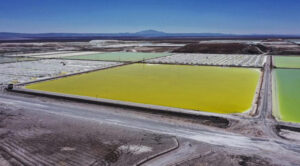
An aerial view of brine ponds and processing areas of the lithium mine of the Chilean company Sociedad Quimica Minera (SQM) in the Atacama Desert (Photo: Martin Bernetti/AFP via Getty)
The job is barely done in Venezuela, and we are invited, not least by Trump courtiers themselves, to ask, where next? On the menu are the overthrow of the elected leader of Colombia, a coup against the Cuban regime and even a shock-and-awe (or land-and-ice) grab for Greenland.
This pageantry is all part of a White House plan, laid out in last year’s national security strategy, to make the US “pre-eminent” in the Western Hemisphere, protecting its “access to key geographies throughout the region”.
But beneath the bluff, bluster and misdirection from Donald Trump and his team are common and consistent themes: around treasures found under the ground and the US goal, as outlined in the strategy, to “own or control strategically vital assets, in our Hemisphere”.
Venezuela’s oil has been on Trump’s mind lately, but perhaps equally important is the exploitation and processing of resources like rare earths, lithium and other strategic minerals.
The US is desperately in need of sources outside Africa and Asia for these vital elements, used for a range of products from phones and computers to electric cars. “I think this is one of the really big considerations in America’s foreign policy,” says Adrian Binks of leading energy analysts Argus Media.
It is part of the reason Trump said on Tuesday that the US is discussing “a range of options” to acquire Greenland.
He claims the semi-autonomous Danish territory is necessary for America’s strategic defence across the Arctic. “It’s full of Chinese and Russian ships,” was a recent, bizarre, comment about the great frozen island. While its mineral riches will be difficult to extract, he is determined to keep the Russians and Chinese out of this chunk of the frozen North – in what is known in strategy lingo as “area access defence denial”.
Argentina, Brazil and Chile, meanwhile, have known reserves, and it is suspected much more is yet to be discovered.
The minerals race is the new Great Game and will feature increasingly in the Trump agenda in a way that earlier expansionist US presidents like James Monroe, William McKinley and the two Roosevelts could hardly have dreamed of.
Chile is particularly attractive – rich in copper, as well as rare earths and lithium. More to the point, Chile is pioneering processing facilities for rare earths.
The US will want to buy or take over these as they mature, to break its dependency on China, which controls about 90 per cent of processing worldwide. “Processing this material is a messy, dirty and dangerous business, with a high risk to life,” one energy intelligence expert told me this week. “America doesn’t want this on its own turf, if it can be avoided.”
As for Colombia – a functioning democracy, with President Gustavo Petro due to leave office this summer, and a strong military – Trump is looking for loyalty and stability more than natural resources and oil, staunching of the flow of cocaine and migrants.
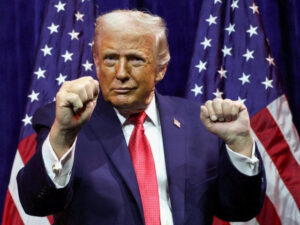
Beneath the bluff, bluster and misdirection from Donald Trump and his team are common and consistent themes (Photo: Reuters/Kevin Lamarque)
This is summed up by Trump’s warning to Petro that he “had better watch his ass”. He doesn’t want to intervene, but can mount an operation from the same flotilla overseeing Venezuela from the Caribbean.
Trump doesn’t do alliances – he prefers clients, proxies and patsies. His approach to smaller allies is to browbeat or ignore them.
When it comes to oil, the big players in the region, according to analysts like Binks, are Venezuela, new kid on the block in Guyana, as well as Brazil and Argentina.
Venezuela has the biggest recognised oil reserve in the world, a potential of above 300 billion barrels, mostly in the Orinoco River Basin (Saudi Arabia is next, with an estimated 27 billion barrel reserve). However, while Venezuela’s heavy crude is highly valued, its exploitation is difficult and the country’s oil represents only one per cent of oil currently traded on the world market.
Managing Venezuela’s oil will be a delicate matter. Trump is likely to try to subcontract the job to oil giants like Chevron, recently allowed back into Venezuela, and BP. This hands-off approach, minus the military raid, could be used in working with the astonishing success story of Guyana’s offshore oil and gas industry, which generates around a million barrels a day, from almost nothing two decades ago.
Argentina is being propped up by the US to the tune of $4bn, not only because President Javier Milei is Trump’s principal Latin American fan boy, but because of its mineral and hydrocarbon prospects. Argentina is pioneering new rounds of fracking and can claim the huge offshore Malvina Basin, running from Brazil to Antarctica, which could soon become commercially viable. Argentina also has access to Antarctica, which is likely to be exploited soon, despite the Antarctic Treaty of 1959.
Major nearby energy producers, Mexico, Brazil and Canada, are rich in oil reserves, and largely unexplored mineral and rare earth materials. They are now regulars on the list of Trumpian “frenemies”, though Washington seems to accept that some sort of partnership with them is needed, rather than a fight. All three are too big to be susceptible to the kind of tactics used last week in Venezuela – he simply doesn’t have enough conventional forces.
In the long game over resources, the strategic elements, rare earths and minerals are likely to be the deciders. And big prospects lie in the south – Antarctica and the cone countries of Argentina and Chile – as much as in the north.
Exploiting the mineral resources of the south – Antarctica especially – is well beyond the span of Trump’s presidency or his immediate successors. It would need delicate trade-offs in Antarctica, with nations that have powerful voices, despite their size on the global stage – Britain, Norway, Australia especially – and courting China, a big investor in Antarctica.
The mineral race in the deep south may not come until after 2050, after some notional year of “peak oil”, the highest volume of hydrocarbon consumption – oil and petroleum, natural gas and coal – in world history.
Meanwhile we are in for a bumpy ride – not least for the UK over the Falklands as the surrounding waters, the Malvina Basin, becomes a target for commercial exploitation. The current stand-off between Britain and Argentina is not something Trump’s team will tolerate much longer.
Energy and strategic defence are the immediate priorities for Trump’s “Donroe Doctrine” outlined in November’s national security strategy. The long game, however, is the race for strategic elements and minerals.
Courtesy/Source: The Guardian