


















































































SEPTEMBER 10, 2025

Temples protected by gods.
Rukmini, the daughter of Bhishmaka of Vidarbha and the chief queen of Krishna in Dwarka, is revered in texts as the very incarnation of Goddess Lakshmi. Yet her place in living worship is uneven across India. In South Indian temples, she is inseparable from Krishna’s divine form, invoked in rituals, marriage festivals, and daily prayers. In contrast, North Indian devotion revolves around Radha, the eternal beloved of Krishna’s Braj pastimes. This divergence is not accidental but the result of theological choices, historical developments, and cultural memory that shaped how people see Krishna and his consort.
1) Royal Krishna versus Pastoral Krishna
In South India, temple traditions highlight Krishna as Vishnu in his majestic form, ruling as a king in Dwarka. This royal image naturally includes his wedded queen, Rukmini. In the North, devotion emphasizes Krishna’s Vrindavan lila, where he appears as the cowherd boy immersed in love with Radha. The difference in which aspect of Krishna is remembered decides which consort becomes central in worship.
2) Influence of Agamas and Temple Rituals
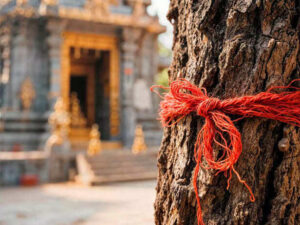
Temples.
South Indian temples are guided by Vaikhanasa and Pancharatra Agamas, which insist that the deity is accompanied by his consort. Since Rukmini represents Lakshmi in Krishna’s Dwarka form, she is consistently installed beside him in shrines. Northern temples, shaped more by local bhakti currents than Agamic codes, developed around the Braj narrative that centers Radha instead.
3) Scriptural Mapping of Roles

Dwarka, Gujarat.
The Puranas clearly separate Krishna’s two spheres: Radha in the pastoral Vrindavan lila and Rukmini in the royal Dwarka lila. Southern liturgy aligns with the Dwarka narrative, where Krishna appears as a sovereign and Rukmini as his chief queen. Northern devotional traditions place their heart in Vrindavan, making Radha the eternal focus.
4) The Sri Vaishnava Lens on Lakshmi
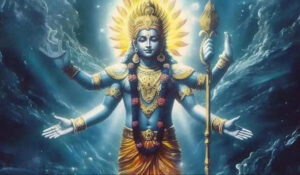
Lord Vishnu.
Sri Vaishnavism, deeply rooted in Tamil land and codified by Ramanuja, gives Lakshmi a permanent, inseparable role beside Vishnu. Since every avatar of Vishnu appears with Lakshmi, Krishna’s queen Rukmini is worshipped as Lakshmi’s form in temples. This theological framework ensures her prominence in the South.
5) Rise of Radha in North Indian Bhakti
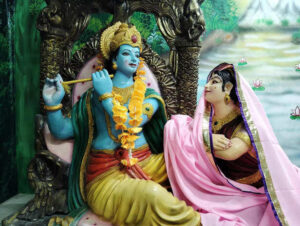
A vibrant depiction of Radha gazing lovingly at Lord Krishna, symbolizing eternal devotion and divine connection.
The spread of Gaudiya Vaishnavism from the 16th century elevated Radha to supreme status as Krishna’s internal energy and highest devotee. Temples, poetry, and music across Braj, Bengal, and later the entire Hindi belt placed Radha and Krishna together at the center of worship. In this theological climate, Rukmini remained respected but less prominent in daily devotion.
6) Sacred Geography and Pilgrimage Circuits
Geography determines memory. South Indian pilgrimage networks revolve around Vishnu’s great temples, where Krishna appears as a royal deity with Rukmini. In the North, the land of Braj itself is seen as Radha’s home, and her presence permeates every festival, song, and shrine. Worship naturally mirrors the land’s sacred story.
7) Art, Music, and Cultural Retelling
Classical Music.
Southern performing arts like Harikatha and Yakshagana often narrate the Rukmini Kalyanam, reinforcing her role in people’s imagination. Northern devotional literature, from Surdas to Chaitanya’s followers, poured its creativity into Radha’s songs and her love for Krishna. Art and performance created lasting cultural archetypes, giving Radha or Rukmini a different intensity depending on region.
8) Domestic Worship and Popular Imagery
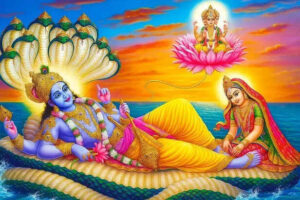
Vishnu-Lakshmi
In South Indian homes, Vishnu-Lakshmi pairs dominate domestic shrines, and when Krishna is worshipped in this frame, Rukmini naturally appears. In North India, household altars and mass-printed calendar images mostly feature Radha and Krishna, reflecting the dominance of Braj bhakti in family devotion. Over time, these images shaped how generations remembered Krishna’s consort.
The Queen and the Beloved
The difference between Rukmini’s southern prominence and her quieter presence in the North is not a contradiction but a reflection of the many dimensions of Krishna himself. Some see him as a sovereign king, others as the eternal lover of Vrindavan. The goddess beside him changes with the lens through which he is remembered. The real question, then, is this: do we limit the divine by choosing one story, or do we embrace the fullness of Krishna that holds both Radha’s eternal love and Rukmini’s eternal grace?
Courtesy/Source: TimeLife / PTI