






























































JANUARY 8, 2026
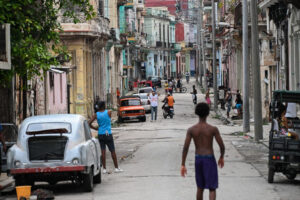
Havana, Cuba’s capital. The country’s economy has imploded. – Yamil Lage/AFP/Getty Images
Elderly Cubans are digging through garbage for scraps of food in Havana. In the country’s second city, Santiago, crowds have gathered, blaring music by Cuban exiles such as Gloria Estefan and Willy Chirino, who sings “Our day is coming soon.”
The U.S. ouster of Venezuelan dictator Nicolás Maduro has jolted this country of fewer than 10 million people, which has long relied on Venezuela for oil imports that have barely kept its tiny economy from collapsing.
It opens a new and perilous chapter for the island’s Communist regime during an economic implosion that already rivals the crisis suffered by Cuba after the collapse of the Soviet Union more than three decades ago.
In poorer cities, people are openly speculating about whether the U.S. will topple the government of Cuban President Miguel Díaz-Canel, the successor to Raúl and Fidel Castro, the siblings who led the Cuban Revolution in 1959 that sent shock waves across Latin America.
“They are nervous,” Manuel Cuesta Morúa, a Havana-based political activist, said of the government. “Repression will increase, it’s the typical response.”
Cuba’s state security apparatus has long had a tight grip on all levels of society, from workplaces to schools or concert halls. But Maduro’s capture risks upending the government’s control of every street, its deep surveillance system and its vast network of snitches, say Cuban dissidents and former officials.
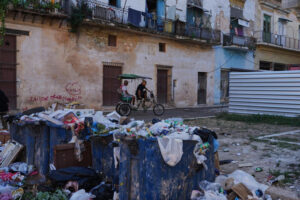
Heaps of trash mar downtown Havana. Blackouts and water shortages are common in Cuba. – Ramon Espinosa/AP
Two days after Maduro’s ouster, Reynaldo Flores was dealing with his fifth consecutive day without running water at his apartment in Havana. It is his new normal, along with the daily blackouts, the failing healthcare system, the trash piled high along the streets, and his aching joints from the mosquito-borne illnesses that have plagued the island.
“Six, seven, 10 days go by with no water,” said 66-year-old Flores. “Then when the water returns, there’s no electricity to pump it in.”
Recently, he said, there was one day where he simultaneously had no electricity, no running water and no gas to cook with. Like all Cubans, Flores saves water in a tank, rationing it for drinking, cooking, washing and bathing. When it runs out, he jumps from one rooftop to another to gather buckets of water from nearby cisterns.
He worries most about the elderly looking for food in the garbage. When they contract a virus, they go to overwhelmed hospitals to die. All of that without taking into account the stifling heat.
“One of my friends works for the government and was just tasked with picking up elderly people who live alone, who’d been dead in their homes for days,” said Flores, who is retired and relies on remittances from relatives abroad.
Cuba has been in a perpetual economic crisis, which has intensified since the Covid-19 pandemic. More than 2.7 million people—about a quarter of the island’s population, the majority of them young and ambitious—have fled the island since 2020, most to the U.S. It is “demographic hollowing out,” said Cuban demographer Juan Carlos Albizu-Campos. He estimates Cuba’s population is now eight million.
The combined result of mass emigration and decreased female fertility is that live births in Cuba plunged to levels below those of 1899, when Cuba emerged from a bloody three-year war of independence that decimated its population, said Albizu-Campos.
“Cuba’s problem was already existential,” said Joe García, a former Cuban-American congressman who speaks often with senior island officials. “On the Cuban side, it’s desperation and worse desperation,” said García, a Florida Democrat.
Tourism, once one of the island’s economic pillars, has plummeted, with hotel occupancy hovering below 30%, according to industry executives. Most tourists, the majority from Russia and China, arrive with all-inclusive packages, meaning that spending doesn’t trickle down to ordinary Cubans as visitors don’t spend much outside their preapproved itinerary.
A new 42-story luxury hotel towers over the once-elegant Vedado district in Havana, Cuba’s capital. Yet the $200 million, Spanish-run hotel is “nearly empty,” said William LeoGrande, a Cuba analyst at Washington’s American University who recently returned from the country.
He estimates that hard-currency income from tourism is down 75%.
Many Cubans rely on remittances from family members abroad. The state relies on billions of dollars collected by the government from thousands of Cuban doctors working in Venezuela, Mexico and other countries, and subsidized Venezuelan oil imports, to keep the lights on. But now the Venezuelan oil spigot could be shut off by the U.S.
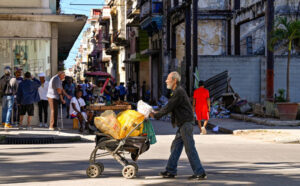
Cuba’s economic crisis has intensified since the pandemic. – Adalberto Roque/AFP/Getty Images
Cuba has no money to buy oil on international markets, and can only hope that friendly countries such as Angola, Algeria, Brazil or Colombia will make up the shortfall if Venezuela, under U.S. pressure, cuts off its supplies, said Jorge R. Piñon, who tracks Cuba’s energy consumption at the University of Texas.
Venezuela has been providing some 35,000 barrels of oil a day of the estimated 100,000 barrels a day the island needs. Cuba produces about 40,000 barrels a day of sulfur- and metals-laden heavy crude that feeds the country’s decrepit power plants. Mexico, which sent about 22,000 barrels a day to Cuba last year, has since lowered shipments to some 7,000, while Russia sends about 10,000 barrels a day, he said.
Cutting off Venezuelan oil would devastate Cuba’s economy.
“I would not be surprised if the Americans tell Venezuela to continue giving oil to Cuba, so as not to open another Pandora’s box,” said Piñon, who calculates oil shipments to the island using reports from services that track tanker movements. Without Venezuelan oil, he estimates Cuba’s energy infrastructure would collapse within 30 days.
As the country struggles to survive, the big question will be the response of Cuba’s leadership, which has ruled with an iron fist since the revolution led by the Castros and their “bearded men in olive green.” The first action of the Communist regime was to require workers to attend a rally over the weekend to denounce Maduro’s capture and declare two days of mourning, with flags at half-staff honoring the 32 Cuban soldiers and high-ranking military intelligence officers who died during the U.S. military incursion.
Without oil there is a risk that the rolling blackouts, which sometimes leave island residents with only four hours of electricity a day, will worsen. Those who have relied on generators to get by will have a hard time running them without access to fuel. Even cooking will be complicated, as some residents have turned to petroleum-run stoves to cook their food.
LeoGrande said that unlike the crisis after the Soviet collapse, a time known as the “special period” when the economic pain was felt across Cuban society, the hardship in this crisis is falling disproportionately on poorer Cubans who don’t have relatives abroad who send them dollars.
“There is more visible inequality,” LeoGrande said. “Poor people are as bad off as in the special period, but a segment of middle and upper class have access to dollars and are not in such bad shape, which causes real social tension.”
Courtesy/Source: WSJ