

























































































OCTOBER 6, 2025
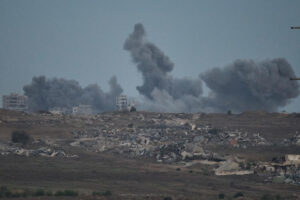
SHARM EL-SHEIKH, Egypt — Israeli and Hamas officials were set to gather Monday in Egypt for high-stakes negotiations over a U.S.-backed plan to end the Gaza war, even as Israel continued to pummel the enclave with heavy air and artillery strikes.
The two sides will converge for indirect talks after months of deadlock to hash out the details of the plan’s first phase — one that mediators hope would see a quick halt to the fighting and the rapid release of Israeli hostages, both dead and living, in exchange for Palestinian prisoners held by Israel and a surge in humanitarian aid.
“We want to see this happen very fast. If it doesn’t, then I think the entire deal becomes imperiled,” Secretary of State Marco Rubio said Sunday of a hostage release on ABC’s “This Week.” He said the talks Monday would focus more narrowly on the logistics of any exchange, before turning to thornier issues such as security and Gaza’s political future. But, he added, “if there’s active combat ongoing, you just can’t do it.”
Khalil al-Hayya, the negotiating lead for Hamas who survived the Israeli assassination attempt last month, arrived in Egypt on Sunday to head its delegation. Israel said its negotiators would arrive at Sharm el-Sheikh Monday; lead negotiator Ron Dermer has not yet joined the delegation, and his arrival would depend on the progress of the negotiations, said a person familiar with the matter, speaking on the condition of anonymity because they were not authorized to discuss government officials’ schedules.
Steve Witkoff, the U.S. Middle East envoy, and Jared Kushner, the son-in-law of President Donald Trump, are expected to join the talks, Egypt’s state-run Al-Ahram newspaper reported; it was not immediately clear when they would join.
Starting Monday, technical teams will work to “clarify the final details” of the plan following “very positive discussions” with Hamas and major Arab and Muslim countries over the weekend, Trump posted on Truth Social on Sunday. He warned that “TIME IS OF THE ESSENCE,” or “MASSIVE BLOODSHED WILL FOLLOW.”
Negotiations to end the two-year-long war were revived last month after Israel launched airstrikes targeting Hamas’s political leadership in the Qatari capital, Doha. Senior Hamas officials emerged from the attack unscathed, but Qatar and their Persian Gulf neighbors, outraged by the operation, leveraged their ties to Trump to push for a ceasefire agreement acceptable to Arab states.
Egypt, Qatar and Turkey pressured Hamas to respond positively to the 20-point plan Trump unveiled a week ago after meeting with Arab and Islamic leaders at the United Nations, and with Prime Minister Benjamin Netanyahu at the White House.
The plan is short on details, but it calls for a phased withdrawal of Israeli forces from Gaza, the disarmament of Hamas and the formation of a committee of Palestinian technocrats to run the enclave’s day-to-day affairs under the supervision of an international body. It also appears to take off the table the most controversial issue, based on an earlier proposal by Trump and Netanyahu, to forcibly displace Palestinians from the territory.
Hamas members who lay down their arms would be offered amnesty, while those who wish to leave Gaza would be provided safe passage, the plan’s outline says.
Hamas and allied militants attacked Israel on Oct. 7, 2023, killing about 1,200 people and taking 251 hostage. Since then, Israel’s military campaign in Gaza has killed more than 67,000 Palestinians, according to Gaza’s Health Ministry, in actions that Israeli and global rights groups, as well as an independent U.N. commission, said amount to genocide.
Still, Hamas wants to see a clear timeline for Israel’s withdrawal, according to a former Egyptian official familiar with the negotiations, speaking on the condition of anonymity to discuss sensitive diplomacy. The group fears that once it hands over the remaining hostages, “the Israelis will say they will not leave,” the former official said.
Mousa Abu Marzouk, a member of Hamas’s political bureau, cautioned in an interview with Al Jazeera last week it would take longer than the 72 hours envisioned under Trump’s plan for the militant group to retrieve the bodies of Israeli hostages. “For some of them, it could take months,” he said.
Hamas also wants a guarantee from the United States that Israel will not resume its attacks in Gaza after the hostages are returned. Egypt is first “trying at least to stop the fire and to release the hostages,” the former official said, after which Cairo hopes Trump can be persuaded to pressure Israel to set a timetable for its withdrawal.
“There are a lot of holes that need to be filled,” Egyptian Foreign Minister Badr Abdelatty said on Thursday. “We need more discussions on how to implement it, especially on governance and security arrangements.”
In a news conference Sunday, Israeli government spokeswoman Shosh Bedrosian said Israel “has agreed to the first phase of this deal,” which she said included the release of all hostages and the redeployment of troops to an initial withdrawal line. The second phase — which she described as the disarmament of Hamas and the demilitarization of Gaza — “will happen either through a diplomatic channel, according to the Trump plan, or by a military route by Israel,” she said.
Trump called on Israel to stop bombing Gaza when Hamas conditionally accepted the deal Friday. On Sunday, Bedrosian said that while the Israel Defense Forces had been ordered to pause its push into Gaza City and halt “certain bombings,” it could still fire for defensive purposes.
While strikes have slowed in other areas of the enclave, residents of Gaza City said there has been no letup in the air, artillery and tank fire.
At least 152 people have been killed in Gaza since Friday, Gaza’s Health Ministry said, with 21 of them killed in the past 24 hours. Some 70 percent of the bodies that arrived in hospitals over the past 48 hours came from Gaza City, according to the ministry.
“Nothing has changed since Hamas agreed to Trump’s deal. If anything, the Israeli strikes have gotten worse,” said Maysaa Nasr, a 34-year-old mother of two in Gaza City. “We face all kinds of weapons, artillery shells, airstrikes, drones and explosive vehicles. Bombing comes from every direction. We are exhausted.”
Significant gaps appear to remain not only between Israel and Hamas, but between Israel and Arab countries whose support will be critical for the implementation of Trump’s plan.
Netanyahu told a group of Israeli hostage relatives on Sunday that he would not allow the Palestinian Authority, which runs the West Bank, to play a role in governing Gaza after the war. But influential Arab and Muslim states insist it must — a stance reiterated in a statement Sunday from the foreign ministers of Egypt, Jordan, the United Arab Emirates, Indonesia, Pakistan, Turkey, Saudi Arabia and Qatar.
Any peace agreement must lead to “the full Israeli withdrawal, and to the rebuilding of Gaza” and create “a path for a just peace on the basis of the two-state solution,” the ministers added.
Hamas has also said it won’t disarm, a key demand of Israel and the United States. The Trump plan calls for a “process of demilitarization of Gaza,” monitored by independent actors, “which will include placing weapons permanently beyond use.”
Egyptian officials have tried to project optimism ahead of the negotiations. But there are plenty of reasons for skepticism, said Hesham Youssef, a political analyst and former Egyptian diplomat.
“Everybody has been waiting since January, or for the last two years, to get something serious. And they feel that this time, at least there is serious talk,” he said. But those hopes may be dashed because “neither Netanyahu nor his coalition has changed their position in any way,” he said.
Some hostages’ relatives, their supporters and opposition politicians have for months accused Netanyahu of prolonging the war to ensure his political survival. Far-right members of his coalition have repeatedly threatened to bring down the government if Israel agrees to a peace deal.
But Netanyahu also faces pressure from the streets as protesters regularly flood Tel Aviv calling for a hostage deal. Before dawn on Monday, Israeli activists set up a giant installation on the beach in Tel Aviv, close to the U.S. Embassy office, that addressed Trump and said: “All Eyes on You.”
Courtesy/Source: The Washington Post