
















































































DECEMBER 7, 2025
Have you ever glanced at a quarter and thought it was just another piece of pocket change? Most of us have.
We toss them into jars, use them for parking meters, or hand them over without a second thought. That ordinary 1983 Washington quarter sitting in your cup holder might actually be worth a small fortune, though.
Honestly, it sounds almost too good to be true, right? Yet some of these coins have sold at auction for jaw-dropping amounts that’ll make you want to dig through every coin jar in your house.
The Perfect Storm That Created a Collector’s Dream
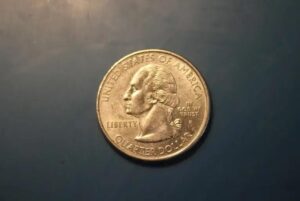
The Perfect Storm That Created a Collector’s Dream (Image Credits: Pixabay)
S. Mint coin sets in 1982 and 1983.
2 billion coins, fewer examples were preserved in mint condition. Think about it: when people are struggling to make ends meet, they’re not exactly putting aside pristine quarters for future collectors.
35 an hour.
Why High-Grade 1983 Quarters Are So Rare
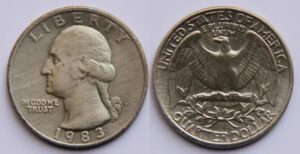
Why High-Grade 1983 Quarters Are So Rare (Image Credits: Wikimedia)
The 1983-P Washington quarter was not saved in large quantities nor was it available in Mint Sets, making it scarcer that its mintage seems. Coins from the early 1980s, including 1983, are relatively scarce in higher grades because they were heavily circulated and fewer were saved in mint condition.
Even though roughly 673 million quarters were minted in Philadelphia and around 618 million in Denver, finding one in pristine condition is like finding a needle in a haystack. In high grae condition the 1983-P ranks as one of the tougher issues in the Clad Washington Quarter series.
In MS66 condition they are very scarce with less than 500 known.
The Record-Breaking Amusement Token Error
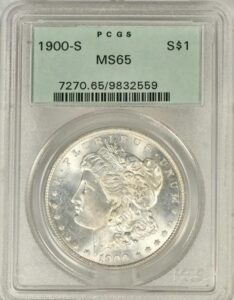
The Record-Breaking Amusement Token Error (Image Credits: Flickr)
Here’s where things get wild. 50 in 2014.
This rare error happens when a 1983 Washington Quarter is struck on a pre-existing amusement token instead of an intended planchet. ” This rare coin, graded MS65 by PCGS, sold for an extraordinary price of $15,862 at Heritage Auctions in 2014!
Imagine: someone’s lucky day token literally became someone else’s lucky day. The quarter has a brassy appearance with a greenish patina instead of the normal silvery color, making it instantly recognizable to experts.
The Famous Spitting Eagle Variety
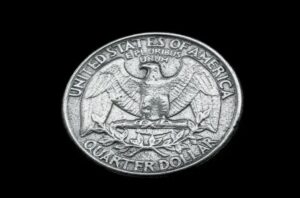
The Famous Spitting Eagle Variety (Image Credits: Unsplash)
This variety features a distinctive raised line extendin from the eagle’s beak on the reverse, creating the memorable appearance that the eagle is spitting. NGC announced in 2013 that it would certify the “Spitting Eagle” edition as a separate series.
What makes this error particularly charming is its nickname and visibility. Coins with this error of XF40 or XF45 grade have a value of one or two dollars.
The mint state value for MS63 is 40 dollars and 500 dollars for MS66+. GreatCollections has sold 6 of the 1983-P Washington Quarter Spitting Eagle in the past 15 years, selling at prices from $63 to $152, in grades 65 to 66.
Off-Center Strikes and Broadstrikes
Off-Center Strikes and Broadstrikes (Image Credits: Pixabay)
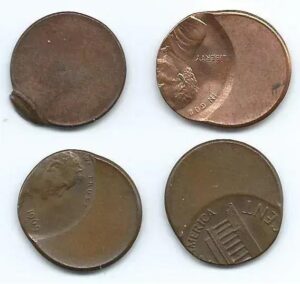
If you are looking for 1983 Quarter errors be sure to look for Broadstrikes. There are a plethora of broadstrike errors to be found this year.
Also look for 1983 double strike errors. So remember the most popular errors for quarters in 1983 are Double die and Broad Strikes.
The coin with 70 percent off-center, just 83 of the date is seen with the lower right edge of the president’s bust and mint mark. It sold for more than 150 dollars at auction.
00 in April, 2018 at eBay Sales 04/08/2018 ~ 04/14/2018, by eBay for an off-center strike graded NGC MS 63.
Finned Rim and Reverse Indent Errors
Finned Rim and Reverse Indent Errors (Image Credits: Wikimedia)
This error occurs when extra striking pressure is used on one side of the coins or completely. It normally looks like a flange about the rim of the coin.
It happens when excessive pressure from the die causes metal to spill over the edge, creating a “flange” or “fin” around the coin’s rim. These coins are more unusual and valuable than standard specimens.
The value is higher than regular uncirculated coins. MS63 1983 P quarter with finned rim sold for $310 at Heritage Auctions.
Value Range: $310 for high-grade examples with reverse indents.
Standard Uncirculated Values Are Still Impressive
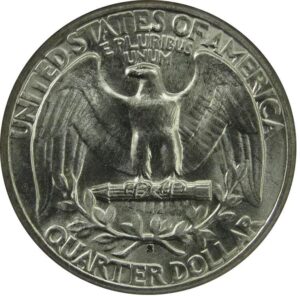
Standard Uncirculated Values Are Still Impressive (Image Credits: Wikimedia)
Even without errors, high-grade 1983 quarters command serious money. Uncirculated coins can fetch $2 to $30, with MS66 grades reaching $40 to $230, and MS67 examples reaching as much as $280 to $2,500 at auction!
The highest price released for an MS67 1983 P mint mark 25C coin is $2,596 at Heritage Auctions. GreatCollections has sold 66 of the 1983-D Washington Quarter in the past 15 years, selling at prices from $6 to $1,519, in grades 1 to 67.
The condition makes all the difference between a quarter and a payday.
How to Identify a Valuable 1983 Quarter
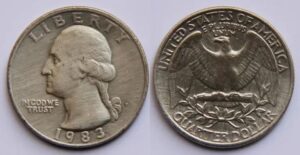
How to Identify a Valuable 1983 Quarter (Image Credits: Unsplash)
Look for the mint mark first, located just behind Washington’s ponytail on the coin’s obverse. Check for any unusual features on the reverse, particularly around the eagle’s beak where the Spitting Eagle variety shows a raised line.
At this grade level, coins retail for $50 to $60. Examine the rim carefully for any flanges or unusual edges.
Look at the overall sharpness of the design. The typical 1983 quarter shows weakness in the lettering, especially the “IN” of IN GOD WE TRUST, and the luster isn’t strong, either.
Courtesy/Source: Business Intelligence | From W.D. Strategies