









































































NOVEMBER 20, 2025
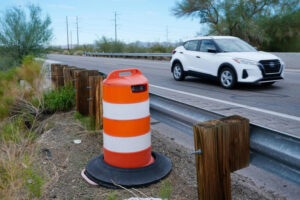
A license plate reader used by U.S. Border Patrol is hidden in a traffic cone while capturing passing vehicles on AZ Highway 85, October 21, 2025, in Gila Bend, Ariz
Millions of American drivers are being monitored by the U.S. Border Patrol to crack down on those with suspicious travel patterns, according to a report.
The Associated Press has reported that people are being stopped, searched and, in some cases, arrested as a result of the secretive intelligence program.
Newsweek contacted Border Patrol’s parent agency, U.S. Customs and Border Protection, via email outside of regular working hours for comment.
Why It Matters
The expansion of the U.S. Border Patrol‘s surveillance program into the nation’s interior has far-reaching implications for privacy, civil liberties and the role of government surveillance in daily American life.
As federal agencies adopt emerging technologies—including artificial intelligence—the debate over how, and whether, Americans’ movements should be tracked has intensified.
According to the American Civil Liberties Union (ACLU), expanded use of license plate readers creates “enormous databases of innocent motorists’ location information” with varying policies on data retention, generating calls for clear regulatory standards and increased transparency.
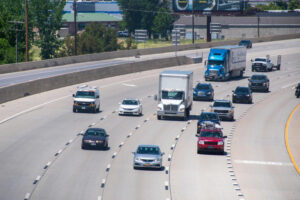
Multiple vehicles travel along Interstate 15 during daytime, captured from an elevated perspective showing traffic flow and highway infrastructure in the area, Orem, Utah – June 2, 2025
What To Know
According to an extensive investigation by The Associated Press, the U.S. Border Patrol is actively monitoring Americans using a vast network of cameras and license plate readers.
Originally designed to combat cross-border crime, the monitoring network now tracks the movements of millions of ordinary drivers far beyond border regions.
Legal scholars, privacy advocates and affected individuals are raising constitutional questions, warning that the program could threaten Americans’ freedom of movement and Fourth Amendment rights.
An algorithm flags vehicles based on criteria such as travel routes, vehicle origin, and destination, identifying “suspicious” patterns that prompt agents to alert local law enforcement for stops and searches.
Cameras are often hidden along highways, sometimes disguised as construction or safety equipment, and are deployed far beyond the agency’s traditional 100-mile jurisdiction, including in major cities and metropolitan areas such as Chicago, Detroit, Los Angeles, San Antonio and Houston.
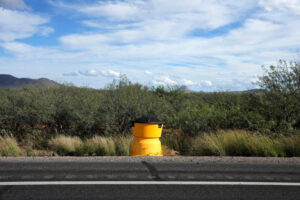
A license plate reader used by U.S. Border Patrol is hidden in a sand crash barrel along the state Highway 80, October 23, 2025, in Douglas, Ariz.
The program represents a significant transformation of U.S. Customs and Border Protection (CBP) into an intelligence-driven operation, especially since new funding of over $2.7 billion is earmarked for advanced surveillance and artificial intelligence technologies.
Data is sourced not only from Border Patrol and Department of Homeland Security cameras, but also commercial networks operated by the Drug Enforcement Administration, private companies such as Rekor, Vigilant Solutions, and Flock Safety, and local police departments—many of which receive grants via Operation Stonegarden to expand their own surveillance operations.
The AP investigation revealed that few details about the border surveillance program make it into court records, as agencies have allegedly gone so far as to propose dropping potential charges rather than disclose technical specifics in police reports.
Drivers have been stopped and searched for behaviors defined by the Border Patrol as suspicious, which may include using a rental vehicle, driving on rural roads or making short trips to border regions.
In at least one case, local law enforcement in Texas pulled over and searched a truck at Border Patrol’s request.
No contraband was found, but the driver, Lorenzo Gutierrez Lugo, was still arrested and his vehicle was seized. All charges were eventually dropped, but only after significant legal costs.
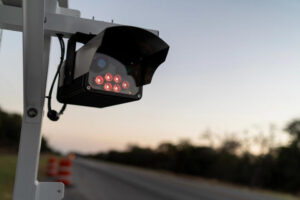
A license plate reader stands along the side of a road, Wednesday, Oct. 15, 2025, in Stockdale, Texas
What People Are Saying
CBP defended its use of license plate readers, stating that the program is “governed by a stringent, multi-layered policy framework, as well as federal law and constitutional protections, to ensure the technology is applied responsibly and for clearly defined security purposes.” The agency added: “For national security reasons, we do not detail the specific operational applications.” According to CBP, while the U.S. Border Patrol primarily operates within 100 miles of the border, it is legally permitted “to operate anywhere in the United States”.
Nicole Ozer, executive director of the Center for Constitutional Democracy at UC Law San Francisco, said, as per the AP: “They are collecting mass amounts of information about who people are, where they go, what they do, and who they know … engaging in dragnet surveillance of Americans on the streets, on the highways, in their cities, in their communities. These surveillance systems do not make communities safer.”
Alek Schott, a Houston resident who was stopped by sheriff’s deputies after Border Patrol agents flagged his travel pattern and has a lawsuit pending alleging constitutional violations, told AP: “I didn’t know it was illegal to drive in Texas. I assume for every one person like me who’s actually standing up, there’s a thousand people who just don’t have the means or the time. They just leave frustrated and angry. I think there are thousands of people getting treated this way.”
Andrew Ferguson, a law professor at George Washington University, said “large-scale surveillance technology that’s capturing everyone and everywhere at every time” might be unconstitutional under the Fourth Amendment.
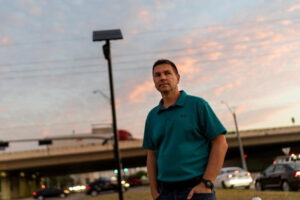
Alek Schott stands next to a Flock Safety license plate reader in his neighborhood, Thursday, Oct. 16, 2025, in Houston
What Happens Next
The scale of data collection—and the lack of transparency around data retention, sharing, and use—remains under scrutiny from courts, privacy organizations, and legislators.
As Congress continues to allocate additional funding to CBP for further developing surveillance technologies, debate is likely to grow over the constitutional limits and oversight needed for mass data collection and predictive analytics applied to ordinary Americans.
Courts and lawmakers may be compelled to clarify the balance between national security and privacy rights as these programs evolve.
Courtesy/Source: Newsweek