



























































































NOVEMBER 5, 2026
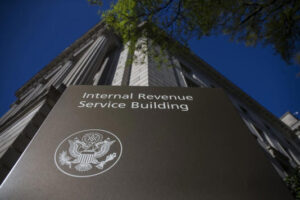
The federal income tax rates remain unchanged for next year. – Zach Gibson/Getty Images
The Internal Revenue Service on Thursday announced the inflation adjustments for 2027 tax brackets and other provisions of the tax code.
For tax year 2027 (tax returns filed in 2028) the standard deduction increases to $33,200 for married couples filing jointly, up $1,000 from this year. For single taxpayers and married people filing separately, the standard deduction rises to $16,600, and for heads of households, the standard deduction will be $24,925. (The additional, temporary senior deduction available to qualifying taxpayers age 65 and older remains fixed at $6,000 through 2028, after which it is set to expire under the One Big Beautiful Bill.)
The federal income tax rates remain unchanged for next year, while the income attached to each bracket gets an inflation boost as follows:
— 37% for individual single taxpayers with incomes greater than $661,375 or $793,650 for married couples filing jointly
— 35% for incomes over $264,550 or $529,100 for married couples filing jointly
— 32% for incomes over $208,325, or $416,650 for joint filers
— 24% for incomes over $109,125 for singles, or $218,250 for joint filers
— 22% for incomes over $52,025 for singles, or $104,050 for joint filers
— 12% for incomes over $12,800 for singles, or $25,600 for joint filers.
—10% for incomes of single people with incomes of $12,800 or less, or $25,600 for married couples filing jointly.
The maximum child tax credit for 2027 is $2,300, up $100 from 2026. For tax year 2027, the amount of credit that may be refundable is $1,800, also up $100 from this year.
The Alternative Minimum Tax exemption is $93,000 for unmarried individuals and begins to phase out at $515,950; the exemption amount is $144,700 for married couples filing jointly, for whom it begins to phase out at $1.03 million.
The annual gift exclusion rises to $20,000 per recipient, up from $19,000 this year. Estates of people who die during 2027 have a basic exclusion amount of $15.48 million from federal estate tax, up from $15 million this year.
The maximum contribution to pre-tax health flexible spending accounts rises to $3,500, up $100 from this year. For plans that permit the carryover of unused funds, the maximum carryover amount is $700, up $20.
Courtesy: The article was originally appeared in Barron’s