




















































































AUGUST 27, 2026
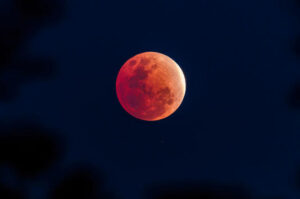
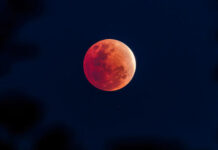
Partial lunar eclipse. Credit: Nicky Dowling/Getty Images
Earth’s shadow will cover 96 percent of tonight’s full Sturgeon moon, creating a dramatic coppery glow visible across the Americas.
After delivering a total solar eclipse and pristine dark skies for the Perseid meteor shower, August is closing a packed stargazing month with a near-total lunar eclipse.
From Aug. 27 to the early morning hours of Aug. 28, Earth’s shadow will slowly cover 96 percent of the full Sturgeon moon, turning the lunar surface a deep coppery red color. The event, the last opportunity to view an “almost blood moon” for over two years, unfolds between 9:23 p.m. and 3:01 a.m. ET.
The partial phase—when Earth’s dark inner shadow (umbra) transforms the color of the lunar surface—begins around 10:33 p.m., reaches maximum coverage at 12:12 a.m., and concludes at 1:52 a.m. ET.
While this eclipse will favor the Americas, with the moon positioned high in the night sky, viewers across Western Europe and West Africa will also witness the peak of near-totality low along the horizon right before moonset at dawn.
In the U.S., the partial lunar eclipse will be visible from all 50 states, weather permitting, but the best views will be in the eastern and central U.S. The entire partial phase will be visible from states including New York, New Jersey, Pennsylvania, Massachusetts, Florida, Georgia, Ohio, Michigan, Illinois, Texas, and Louisiana. Those farther west—including in California, Oregon, Washington, Arizona, and Nevada—will see the eclipse already in progress as the moon rises, while Alaska will miss the main partial phase.
Why will the moon change color?
A partial lunar eclipse occurs when Earth passes between the sun and the full moon, but only part of the lunar surface enters the darkest portion of Earth’s shadow. During this especially deep eclipse, nearly the entire moon will slip into that shadow, leaving only a thin, bright white sliver untouched.
As sunlight passes through the edges of Earth’s atmosphere, shorter blue wavelengths scatter away while the atmosphere bends the remaining red and orange light towards the moon. That filtered light can give the shadowed portion of the lunar surface a coppery glow—the same atmospheric effect that produces vivid sunrises and sunsets.
“You can think of the reddish color as all of the sunrises and sunsets on Earth at that moment reflected off the surface of the Moon,” per NASA Planetary Scientist Sarah Noble.
How to watch the partial lunar eclipse
Unlike August’s earlier solar eclipse, no special glasses or filters will be necessary to safely view this near-total lunar eclipse. Stargazers can observe the ruddy hue of the lunar surface with the naked eye, though binoculars or a small telescope will highlight the sharp, bright contrast along the crescent rim of the moon that remains outside Earth’s umbra.
Should local weather spoil the view, TimeandDate.com will be hosting a livestream of the deep partial lunar eclipse starting at 10 p.m. ET on Aug. 27. The next, more dramatic lunar eclipse arrives on Dec. 31, 2028, when a total lunar eclipse will be visible from much of Europe, Africa, Asia, Australia, Hawaii, and parts of Alaska. Most of North America will have to wait until the night of June 25 to 26, 2029, for its next widespread total lunar eclipse.
Courtesy: The article orginaly posted on Travel + Leisure