






























































































JULY 31, 2026
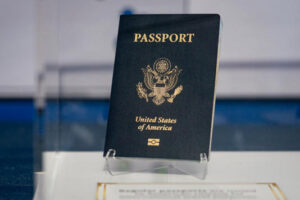
File photo; U.S. passport is on display at the Great American State Fair on July 10, 2026, in Washington, D.C.
The United States has fallen to 10th place in an annual global ranking of the world’s most powerful passports, marking its lowest position since 2016, when it ranked fourth.
The Henley Passport Index compares the visa-free access of 199 passports to 227 travel destinations, and this year’s results place more than 30 countries, which include a number of tied rankings, ahead of the U.S.
The U.S. passport is tied at 10th place with Iceland. Singapore ranks 1st, according to the Henley Passport Index, with Japan, South Korea, and the United Arab Emirates tied for 2nd place.
Experts say the decline does not reflect a sudden collapse in the strength of the American passport. Instead, it highlights how other countries have moved more aggressively to expand travel access for their citizens through new visa-waiver agreements and diplomatic partnerships.
“The American passport remains among the strongest in the world,” Richard T. Herman, a U.S. immigration attorney and founder of the Herman Legal Group, told Newsweek. However, he added, “the direction is a warning: American power still opens doors—it simply no longer opens more doors than everyone else’s.”
A spokesperson for the U.S. Department of State told Newsweek that Americans enjoy visa-free or visa-on-arrival access to hundreds of destinations worldwide, which they believe reflects the close partnerships the U.S. maintains with countries across the globe.
The department’s focus remains on facilitating secure, efficient, and reciprocal travel for Americans and foreign nationals alike, the spokesperson said.
When contacted for comment, a spokesperson for the White House referred Newsweek to the Department of State.
Security-Focused Policies and Limited Reciprocity
According to experts, one factor behind the declining ranking is the gap between the travel access Americans receive abroad and the access the U.S. offers to foreign visitors.
Herman noted that Americans can travel to around 180 destinations, according to the latest index, without obtaining a visa in advance, while the U.S. currently permits visa-free entry under its Visa Waiver Program to citizens of only 42 participating countries. He said that imbalance does not solely determine passport rankings but reflects “an increasingly transactional approach to international mobility.”
Tom Topol, a historical travel documents and travel history expert, said countries such as Singapore, Japan, and several European nations have continued negotiating broad visa-waiver agreements while the U.S. has maintained “strict, security-focused immigration policies at home.”
He told Newsweek that this approach has contributed to the U.S. losing ground in a global environment where other nations are rapidly expanding reciprocal travel arrangements.
Professor Usha Haley, the W. Frank Barton Distinguished Chair in International Business at Wichita State University, told Newsweek that visa access often depends on reciprocity. She said: “Security concerns, the politics around immigration, and the U.S. Visa Waiver Program’s demanding requirements limit Washington’s ability to offer reciprocal access.”
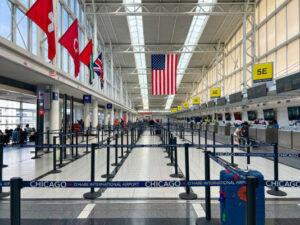
A nearly empty terminal is seen at Chicago O’Hare International Airport in July 2024.
The Most Powerful Passports, According to Henley’s Global Ranking:
- Singapore: 1st
- Japan: 2nd
- South Korea: 2nd
- United Arab Emirates: 2nd
- Sweden: 3rd
- Belgium: 4th
- Denmark: 4th
- Finland: 4th
- France: 4th
- Germany: 4th
- Ireland: 4th
- Italy: 4th
- Luxembourg: 4th
- Netherlands: 4th
- Norway: 4th
- Spain: 4th
- Austria: 5th
- Greece: 5th
- Malta: 5th
- Portugal: 5th
- Switzerland: 5th
- Hungary: 6th
- Poland: 6th
- United Kingdom: 6th
- Australia: 7th
- Canada: 7th
- Czechia: 7th
- Latvia: 7th
- Malaysia: 7th
- New Zealand: 7th
- Slovakia: 7th
- Slovenia: 7th
- Croatia: 8th
- Estonia: 8th
- Liechtenstein: 9th
- Lithuania: 9th
- Iceland: 10th
- United States: 10th
Other Countries Expand Access
Experts pointed to recent developments that have benefited competing passports.
Herman said Europe and other competitors have gained from regional cooperation and new visa concessions, including China’s decision to admit citizens of several European countries without visas. Meanwhile, he noted, the U.S. remains one of the few highly ranked passport countries whose citizens still need visas to enter China.
Topol also cited China’s unilateral visa waivers as an example of foreign initiatives that have excluded the U.S. He said American passport holders are being “left behind in a rapidly opening global landscape.”
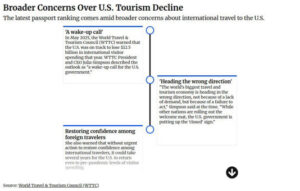
US Passport Drops to Lowest Ranking in Decade: ‘The Direction Is a Warning’
At the same time, some countries have moved in the opposite direction toward American travelers. Topol pointed to Brazil’s decision to reinstate visa requirements for U.S. citizens, arguing that a “lack of reciprocity” has contributed to such policy changes.
Haley said countries including Singapore, Japan, South Korea, and the United Arab Emirates have “negotiated new access more aggressively” than the U.S. In her view, those nations have been more successful at converting diplomatic and commercial relationships into greater mobility for their citizens.
What This Says About the US
Despite the decline, experts stressed that the U.S. passport remains highly valuable.
“The United States has not suddenly become weak,” Haley told Newsweek, describing the decline as a structural trend that has unfolded across “both Republican and Democratic administrations, making it a structural trend rather than the consequence of any single president.”
Haley added that “the trend, however, does signal a gradual erosion in diplomatic agility and soft power as other governments cultivate broader networks of reciprocal relationships.”
Similarly, Herman argued that the story is less about Americans losing access abroad than about other nations improving their own positions. The American passport remains “extraordinarily powerful,” he said, but America’s relative advantage has diminished as other countries have opened more doors for one another while the U.S. has largely stood still.
For Herman, the broader lesson extends beyond travel. A passport, he said, is “a pocket-sized report card on a country’s relationships with the world,” and countries that continually invest in relationships built on “diplomacy, trust and, often, reciprocity” are the ones most likely to climb the rankings.
“The larger message is that global influence cannot be taken for granted,” Herman said. “A country that wants its citizens welcomed around the world must keep investing in diplomacy, alliances, and mutual openness.”

Signage at the arrivals area is seen with travelers at Newark Liberty International Airport in New Jersey, pictured in April 2025.
US Ranking Among World’s Most Powerful Passports Over Past Decade
Based on the annual rankings from 2016 to 2026 in the Henley Passport Index:
- 2026—10th
- 2025—9th
- 2024—7th
- 2023—7th
- 2022—6th
- 2021—7th
- 2020—7th
- 2019—6th
- 2018—5th
- 2017—5th
- 2016—4th
Courtesy: Newsweek