

















































































SEPTEMBER 7, 2025
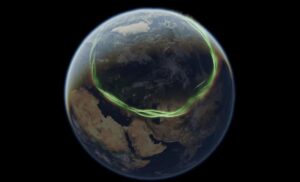
Credit: Maximilian Schanner (GFZ Helmholtz Centre for Geosciences, Potsdam, Germany) | The Daily Galaxy – Great Discoveries Channel
A recent study published inScience Advances reveals that a temporary collapse of Earth’s magnetic field, known as the Laschamps Excursion, had profound effects on early humans.
Drawing from multidisciplinary research led by archaeologists and geophysicists, and echoed in an article from The Conversation, this new insight connects space weather phenomena to fundamental shifts in human adaptation, culture, and survival strategies.
What Was The Laschamps Excursion? A Magnetic Field Breakdown With Global Impact
Around 41,000 years ago, Earth’s magnetic poles behaved unpredictably. Instead of a full reversal—a phenomenon that occurs every few hundred thousand years—the geomagnetic field collapsed to less than 10% of its current strength. This period, known as the Laschamps Excursion, lasted roughly a thousand years, during which the magnetic field fragmented into multiple weak poles scattered across the globe.
Under normal conditions, Earth’s magnetosphere acts as a protective shield, deflecting solar wind and cosmic radiation. But during the Laschamps event, this defense weakened dramatically. Without this magnetic protection, the Earth’s surface was exposed to elevated levels of ultraviolet radiation, disrupting the climate and possibly affecting biological systems. Simulations suggest that auroras would have appeared not only in polar regions but across much of the mid and even equatorial latitudes, turning the skies into a display that was both mesmerizing and dangerous for humans and animals alike.
The breakdown of the magnetosphere could also have altered atmospheric chemistry, weakening the ozone layer and increasing genetic mutations, skin cancers, and birth defects. This made Earth a harsher and more unpredictable environment, forcing humans to rethink how they interacted with their surroundings.

Image. – Daily Galaxy US
How Early Humans Responded: Caves, Clothing, And Red Ochre
While the geomagnetic chaos unfolded invisibly in the skies, the archaeological record reveals tangible changes in human behavior, especially in Europe, where the effects were most intense. Archaeological findings indicate a noticeable increase in cave habitation, suggesting that early humans sought shelter from elevated radiation levels. Caves, previously used intermittently, became primary living spaces for long durations, offering both safety and social cohesion.
Another adaptive strategy was the development and widespread use of tailored clothing. Evidence from bone tools and wear patterns suggests that both Neanderthals and Homo sapiens began creating more sophisticated garments, possibly as a response to increased exposure and variable climatic conditions. Clothing offered both thermal insulation and protection from solar radiation.
Most intriguingly, the use of ochre—an iron-rich mineral pigment—gained prominence during this time. Archaeological sites show that ochre was not only used for symbolic purposes like cave art, but also applied directly to the skin. Modern research confirms that ochre has UV-protective properties, making it a rudimentary but effective prehistoric sunscreen. These behavioral adaptations suggest a level of environmental awareness and technological innovation that challenges outdated views of prehistoric humans as passive victims of nature.

Image. – Daily Galaxy US
Why This Matters Today: Space Weather Isn’t Just Science Fiction
The Laschamps Excursion offers more than a glimpse into deep history; it provides a cautionary tale about the present and future. Earth’s magnetic field is once again weakening, particularly over the South Atlantic Anomaly, raising questions about how future collapses might affect our electronic infrastructure, climate systems, and even human health.
Unlike in the past, modern civilization depends on satellites, aviation, electrical grids, and GPS—all of which are vulnerable to solar radiation. Understanding how our ancestors coped with cosmic disruptions can offer insights into resilience planning. For example, just as prehistoric people turned to caves, today’s engineers design hardened data centers and solar shielding for spacecraft.
Moreover, integrating space weather into archaeological models, as this study does, challenges conventional boundaries in science. It shows that human evolution cannot be fully understood without acknowledging the cosmic forces that shape our environment. It also underscores the value of interdisciplinary research, where archaeology brings the human perspective to phenomena traditionally seen through a geophysical lens.
Beyond Neanderthal Extinction: Rethinking Human Prehistory
It is tempting to draw a straight line between the Laschamps Excursion and major events such as the extinction of Neanderthals. But the authors of the study caution against this. There is no direct evidence that geomagnetic collapse caused their disappearance. Rather, the period should be seen as a multifactorial environment, where radiation, climate variability, and interspecies competition created a complex adaptive landscape.
What the evidence does support is that Neanderthals and modern humans responded differently to environmental stress. While both groups employed protective strategies, Homo sapiens seemed more inclined to innovate, diversify, and adjust socially—traits that likely contributed to their long-term survival. This reinforces the theory that cognitive flexibility was a key driver in human evolution, shaped not only by terrestrial forces but also by celestial disruptions.
Courtesy/Source: Daily Galaxy