















































































MAY 3, 2025
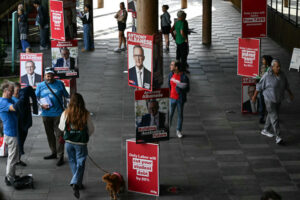
Posters of Australia’s Prime Minister Anthony Albanese outside a polling center in Sydney. – saeed khan/Agence France-Presse/Getty Images
SYDNEY, AUSTRALIA — Australian Prime Minister Anthony Albanese was returned to power in an election Saturday, the latest left-leaning leader to achieve a comeback victory as President Trump roils global markets and upends international affairs.
As of about 11 p.m. Sydney time, Albanese’s Labor Party was projected to win at least 87 seats in the nation’s House of Representatives—where governments are formed—defeating the conservative bloc of the Liberal and National parties, which was projected to win at least 40, according to the Australian Broadcasting Corp.
The result was a decisive win for Albanese, whose party expanded its majority in the 150-seat chamber. Before the vote, polls showed Albanese leading, but not by much.
“Our government will choose the Australian way, because we are proud of who we are,” Albanese told a cheering crowd at Labor headquarters. “We do not need to beg or borrow or copy from anywhere else.”
The election is the latest snapshot of how voters are reacting to a shifting world order as President Trump targets countries with tariffs, pivots toward Russia and uses harsh rhetoric about Washington’s traditional allies. Polls show voters in Australia, Canada, and the U.K. view Washington more unfavorably since Trump took office.
Earlier this week, Canadians gave the left-leaning Liberal Party a fourth term in office, even though the party was trailing badly in the polls at the start of the year. Canadians embraced the tough-talking approach of Prime Minister Mark Carney, a former central banker, while shying away from the conservative candidate, Pierre Poilievre, who was viewed as being too similar to Trump.
A similar dynamic has played out in Australia. Albanese was down in the polls at the start of the year, though by a narrower margin than Canada’s Liberals. As the election grew closer, the polls flipped and showed Albanese ahead. Much of the campaign centered on how best to address the high cost of living, inflation and affordable housing. But Albanese and his main conservative opponent, Peter Dutton, also sparred frequently over who could best negotiate with Trump.
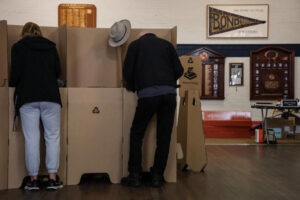
A polling station in Sydney. – david gray/Agence France-Presse/Getty Images
Albanese characterized his government as a pair of steady hands, which could be firm when necessary but wouldn’t overreact. Dutton countered that his party successfully got a tariff exemption from Trump when it was last in office and that Albanese hadn’t done enough.
“Generally, Australian elections don’t really feature foreign policy as much as they have at this point,” Zareh Ghazarian, head of politics at Monash University, said shortly before Saturday’s vote. In these economically uncertain times, he said, “talking about maintaining the status quo has resonated.”
Dutton, a former police officer and defense minister, seesawed between embracing policies with a Trump-like flair and distancing himself from Trump-style rhetoric. He backtracked or clarified proposals to end working from home and slash the government workforce, two initiatives that have been supported by Trump in the U.S.
Later in the campaign, he leaned into culture-war issues, and said he opposed indigenous land acknowledgments at annual ceremonies meant to honor Australia’s war dead. He also unveiled plans to further boost Australia’s military spending, aligning himself with Trump’s demand that U.S. allies to spend more on their militaries.
But the strategy seemed to backfire in a country where Trump is very unpopular. Dutton lost his seat to the Labor candidate.
“Those initial policy announcements basically made it easier for the Labor side here to convince voters that Dutton was trying to emulate Donald Trump,” said Kos Samaras, a director at Redbridge Group, a bipartisan polling and market research firm. Samaras previously worked on campaigns for Labor.
In a battleground electorate in Sydney’s inner west suburbs, Jack Cordukes, a 33-year-old musician, said he planned to support Labor. When asked who would best handle Trump, Cordukes said Albanese is an experienced politician and is good with diplomacy, and that he felt safe with Albanese’s foreign minister, Penny Wong.
“It’s terrifying, how like we saw a few weeks ago with the stock market, and just how much volatility he can create with the things that he says,” Cordukes said of Trump.
Dutton called Albanese to concede. “We’ve been defined by our opponents in this election which is not the true story of who we are,” he said. But members of his party were already debating whether it needs to disavow Trump-like tactics.
“It would be very dangerous for my party to ape some of President Trump’s positions,” James McGrath, a Liberal senator, said on television. “We are a free trade party. We’re pro-Ukraine. We must continue to be that center-right party.”
Albanese, though, had to be careful not to position himself as too anti-Trump given that the U.S. is Australia’s main military partner. He will now have to navigate thorny issues including trade talks and a plan for Australia to buy nuclear-powered submarines from Washington, as concerns mount about America’s shipbuilding capacity and whether the Trump administration might alter the deal.
He also faces a delicate balancing act with China, which is Australia’s biggest trading partner but has been boosting its military and competing with the U.S. for influence in the Indo-Pacific region. Shortly before the campaign, Chinese naval ships conducted exercises close to Australia, raising worries about Australia’s military preparedness.
“Ordinarily, security concerns in political discourse are about China, Russia, cybersecurity, illegal immigration,” said Justin Bassi, executive director at the Australian Strategic Policy Institute, a government-funded think tank. “Here the security discussion has been, can we trust our most significant security ally?”
Courtesy/Source: WSJ