




























































































APRIL 10, 2025
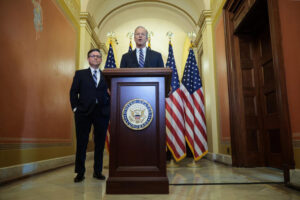
Senate Majority Leader John Thune, center, and House Speaker Mike Johnson at a press conference on Thursday. – Kayla Bartkowski/Getty Images
WASHINGTON, D.C. — House Republicans narrowly approved the blueprint for President Trump’s “one big, beautiful bill” after a late push by party leaders won over some conservatives who had worried that the plan doesn’t force deep enough spending cuts.
The 216-214 on Thursday marks a major step forward for Trump’s legislative agenda, and notches a much-needed win for the White House after Trump put some of his tariffs on hold a day earlier. House passage of the measure unlocks a procedural fast track for a bill later this year that would extend expiring tax cuts, lower taxes even further and increase spending for border security and national defense.
Two —Thomas Massie of Kentucky and Victoria Spartz of Indiana—joined Democrats in voting against the measure. But the rest of the conference fell in line, helping the party eke out a win in the narrowly divided chamber.
Holdout Republicans had been wary about backing the plan that came out of the Senate last Saturday, concerned that senators aren’t as committed to lowering spending as House members are. On Thursday morning, House Speaker Mike Johnson (R., La.) and Senate Majority Leader John Thune (R., S.D.) stood side-by-side and said they were aligned on plans to lower spending, trying to provide enough of an assurance about spending cuts in the final bill to get the fiscal framework over the finish line now.
Thune said Thursday that a lot of senators favor cutting at least $1.5 trillion in spending. That commitment isn’t written or binding and doesn’t necessarily reflect what a majority of senators will do on the final bill. But that comment and other commitments proved to be enough to get the budget over the finish line.
“We’re certainly going to do everything we can to be as aggressive as possible,” Thune said.
Thursday’s vote, in many ways, was the easy part for Republicans, because party leaders were able to defer tough choices by telling lawmakers that this was just a process vote and that they could fight for more later.
Republicans will now attempt to write a bill that encompasses much of Trump’s legislative agenda, then try to steer it through the House and Senate with no more than three votes to spare in each chamber.
Republicans agree broadly on major planks, such as extending tax cuts from Trump’s first term that expire Dec. 31 and providing hundreds of billions of dollars for border security and national defense.
But they are sharply divided on spending cuts, particularly on Medicaid. Conservatives want to add work requirements and reduce the federal share of the expansion that occurred as part of Obamacare. But House moderates and some senators—including Susan Collins (R., Maine), Lisa Murkowski (R., Alaska) and Josh Hawley (R., Mo.)—have been pushing back against such changes.
On taxes, Republicans are likely to split over several issues. Blue-state House members want a significant increase in the $10,000 cap on state and local tax deductions, while others warn that it effectively subsidizes state governments. Some Republicans want to keep clean-energy tax breaks that Democrats expanded in 2022 and that are creating investments in their districts, while others see those tax credits as unnecessary and an obvious target to generate hundreds of billions of dollars.
The budget approved Thursday will provide only a minimal guide for that work ahead. It contains a House plan and Senate plan that don’t match each other.
The House plan requires at least $1.5 trillion in spending cuts over a decade and allows $4 trillion in tax cuts. If spending cuts go up, the tax cuts can increase.
The Senate plan, meanwhile, locks in just $4 billion of spending cuts and allows more than $5 trillion in tax cuts. Senators said they were aiming for far larger spending cuts but wanted to preserve flexibility as they write the bill.
Courtesy/Source: WSJ